NGC 6910
NGC 6910 is an open cluster in the constellation Cygnus, magnitude 7.4, 6.3′ across.
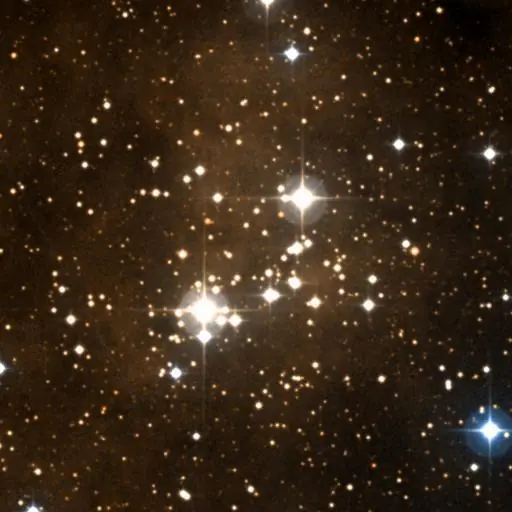
The Inchworm: a young cluster beside Sadr on the sky, but far behind it, beyond the Great Rift.
On the sky NGC 6910 sits just beside Sadr, the star at the heart of the Northern Cross. In reality Sadr is a foreground star; the cluster lies far behind it, beyond the dark dust of the Great Rift, perhaps alongside the glowing Gamma Cygni Nebula, IC 1318.
This young open cluster is the core of a larger family of hot stars, Cygnus OB9. Its members include a blue supergiant, a hot O-type giant and four beta Cephei variables — pulsating hot stars, unusually many for one cluster. William Herschel found it on 17 October 1786.
NGC 6910 is 5,500 light-years away: the light we see from it set off around 3480 BC, 270 years before writing was invented in Mesopotamia.
How big is it?
Born about 13 million years ago, when great apes were spreading through Africa and Europe. Light itself takes 10 years to cross it. Gaia has picked out 273 stars moving together through space as its members. That’s 2.4 times the distance from the Sun to the nearest star. Shrink our Solar System — the Sun and all eight planets — to the size of a coin, and NGC 6910 would be 254 m across (2 football pitches end to end); the nearest star would be a football pitch away, and the Milky Way 2,520 km across.
A 7.4-magnitude open cluster in Cygnus, about 6.3′ across.
When and where to see it
It is best placed in the evening sky around August, when it crosses the meridian at about 10 pm local time (around midnight in July). It can be seen from everywhere north of 49°S and never sets north of 49°N.
At its highest it stands 81° up from 50°N, 84° up from 35°N, 49° up from the equator, 14° up from 35°S.
Facts
- Type
- Open cluster
- Constellation
- Cygnus
- Designations
- NGC 6910
- Magnitude
- 7.4
- Apparent size
- 6.3′
- Position
- RA 20h 23.2m, Dec +40° 47′ (J2000)
- Distance
- 5,500 light-years
- Discovered
- William Herschel, 1786
Open AstroPilot to see when NGC 6910 is highest tonight from your location, how easy it is with your telescope or binoculars, and an eyepiece view.