Blue Flash Nebula (NGC 6905)
Blue Flash Nebula (NGC 6905) is a planetary nebula in the constellation Delphinus, magnitude 11.1, 40″ across.
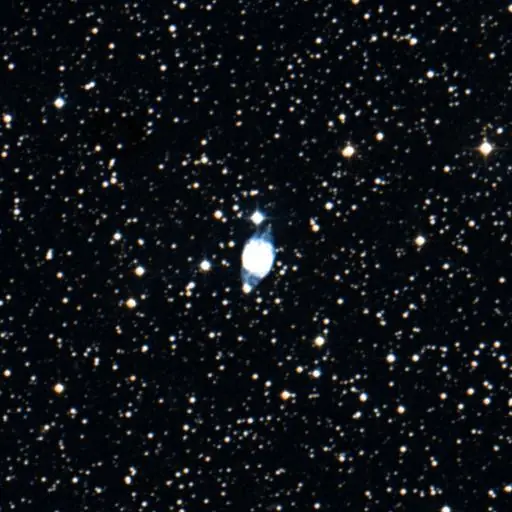
The Blue Flash Nebula: the cast-off shell of a Sun-like star whose naked core burns at 150,000 degrees.
The star at the heart of the Blue Flash Nebula began life only a little heavier than the Sun. Making this planetary nebula cost it nearly half its mass. What remains is a naked core of about 0.6 Suns, blazing at some 150,000 degrees, with a spectrum like an oxygen-rich Wolf–Rayet star.
Around it, an inner shell sprouts cone-like extensions tipped by knots that glow strongly in the light of nitrogen. William Herschel found it in 1784, in Delphinus.
Blue Flash Nebula (NGC 6905) is 8,900 light-years away: the light we see from it set off around 6880 BC, 1,370 years before the first towns were growing in the Fertile Crescent.
Did you know?
- Stripped atoms. Its central star shows some of the broadest lines of highly ionised oxygen — atoms missing five of their eight electrons — seen in any planetary nebula. Oxygen stripped of seven electrons has been detected too: signs of extreme heat.
How big is it?
1,820 Solar Systems side by side. Light itself takes 1.7 years to cross it. Shrink our Solar System — the Sun and all eight planets — to the size of a coin, and the Blue Flash Nebula would be 43.8 m across (about the length of an Olympic pool); the nearest star would be a football pitch away, and the Milky Way 2,520 km across.
An 11.1-magnitude planetary nebula in Delphinus, about 40″ across. Its central star is magnitude 15.7.
When and where to see it
It is best placed in the evening sky around August, when it crosses the meridian at about 10 pm local time (around midnight in July). It can be seen from everywhere north of 70°S and never sets north of 70°N.
At its highest it stands 60° up from 50°N, 75° up from 35°N, 70° up from the equator, 35° up from 35°S.
Facts
- Type
- Planetary nebula
- Constellation
- Delphinus
- Designations
- NGC 6905
- Magnitude
- 11.1
- Apparent size
- 40″
- Position
- RA 20h 22.4m, Dec +20° 6′ (J2000)
- Distance
- 8,900 light-years
- Discovered
- William Herschel, 1784
Open AstroPilot to see when Blue Flash Nebula (NGC 6905) is highest tonight from your location, how easy it is with your telescope or binoculars, and an eyepiece view.