NGC 6891
NGC 6891 is a planetary nebula in the constellation Delphinus, magnitude 10.5, 15″ across.
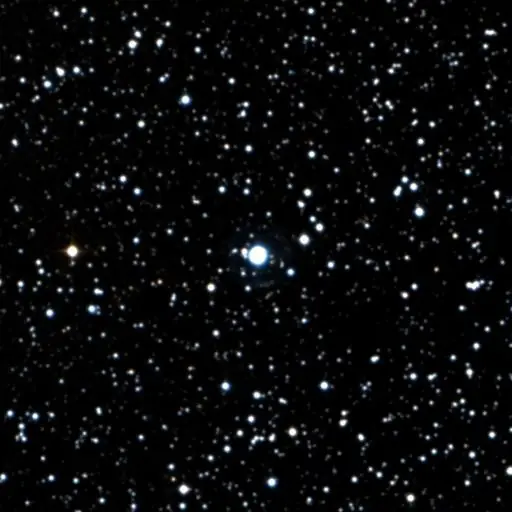
A planetary nebula unmasked by its spectrum in 1884, built from shells thrown off in several bursts.
Ralph Copeland found NGC 6891 not by its shape but by its light. On 22 September 1884, at Dun Echt Observatory near Aberdeen, he was examining the sky through a spectroscope on a 6.1-inch refractor, and its spectrum gave it away as glowing gas.
This planetary nebula is built in layers: a bright inner nebula, an attached middle shell, and a detached outer halo expanding faster than the rest. Inner shells pointing in different directions show that the dying star threw off its gas in several separate episodes.
NGC 6891 is 8,400 light-years away: the light we see from it set off around 6380 BC, 870 years before the first towns were growing in the Fertile Crescent.
How big is it?
642 Solar Systems side by side. Light itself takes 7 months to cross it. Shrink our Solar System — the Sun and all eight planets — to the size of a coin, and NGC 6891 would be 15.4 m across (about the length of a bus); the nearest star would be a football pitch away, and the Milky Way 2,520 km across.
A 10.5-magnitude planetary nebula in Delphinus, about 15″ across. Its central star is magnitude 12.4.
When and where to see it
It is best placed in the evening sky around August, when it crosses the meridian at about 10 pm local time (around midnight in July). It can be seen from everywhere north of 77°S and never sets north of 77°N.
At its highest it stands 53° up from 50°N, 68° up from 35°N, 77° up from the equator, 42° up from 35°S.
Facts
- Type
- Planetary nebula
- Constellation
- Delphinus
- Designations
- NGC 6891
- Magnitude
- 10.5
- Apparent size
- 15″
- Position
- RA 20h 15.2m, Dec +12° 42′ (J2000)
- Distance
- 8,400 light-years
- Discovered
- Ralph Copeland, 1884
Open AstroPilot to see when NGC 6891 is highest tonight from your location, how easy it is with your telescope or binoculars, and an eyepiece view.