Crescent Nebula (NGC 6888)
Crescent Nebula (NGC 6888) is an emission nebula in the constellation Cygnus, magnitude 7.4 (blue), 20′ × 10′ across.
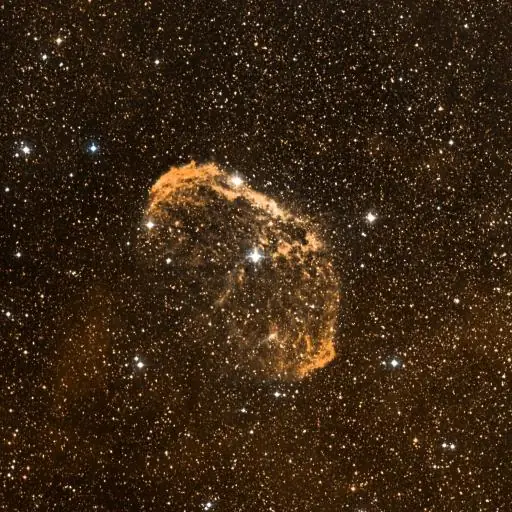
A bubble blown by a doomed star, as its fierce wind smashes into the debris of its own past.
Around 250,000 years ago, the star now called WR 136 swelled into a red giant and began shedding its outer layers in a slow, dense wind. Since then it has changed completely. Stripped down to its blazing hot interior, it has become a Wolf–Rayet star, driving a far faster wind that is ploughing into the material it shed before.
Where the two winds collide, a glowing shell forms: the Crescent Nebula. Two shock waves run from the collision, one outward and one back towards the star, and the inward one heats the gas inside to temperatures high enough to shine in X-rays.
William Herschel discovered this emission nebula in 1792. Wolf–Rayet stars are thought to be in the last stage of life before they explode as supernovae, so the Crescent may one day be torn apart by its own star.
Crescent Nebula (NGC 6888) is 5,700 light-years away: the light we see from it set off around 3680 BC, 470 years before writing was invented in Mesopotamia.
Did you know?
- The Euro Sign Nebula. At higher magnification some observers see a shape like the € symbol in it, which has earned it the nickname “Euro Sign Nebula”.
- A star turned inside out. A Wolf–Rayet star has lost its outer hydrogen, exposing layers that were once buried deep inside. The result is one of the hottest, fiercest types of star there is.
How big is it?
7.8 times the distance from the Sun to the nearest star. Light itself takes 33 years to cross it. Shrink our Solar System — the Sun and all eight planets — to the size of a coin, and the Crescent Nebula would be 837 m across (8 football pitches end to end); the nearest star would be a football pitch away, and the Milky Way 2,520 km across.
A shell of gas blown off by the Wolf–Rayet star WR 136; an OIII or UHC filter shows its crescent shape.
When and where to see it
It is best placed in the evening sky around August, when it crosses the meridian at about 10 pm local time (around midnight in July). It can be seen from everywhere north of 52°S and never sets north of 52°N.
At its highest it stands 78° up from 50°N, 87° up from 35°N, 52° up from the equator, 17° up from 35°S.
Facts
- Type
- Emission nebula
- Constellation
- Cygnus
- Designations
- NGC 6888, C 27
- Magnitude
- 7.4 (blue)
- Apparent size
- 20′ × 10′
- Position
- RA 20h 12.1m, Dec +38° 21′ (J2000)
- Distance
- 5,700 light-years
- Discovered
- William Herschel, 1792
Open AstroPilot to see when Crescent Nebula (NGC 6888) is highest tonight from your location, how easy it is with your telescope or binoculars, and an eyepiece view.