NGC 6885 (NGC 6882)
NGC 6885 (NGC 6882) is an open cluster in the constellation Vulpecula, magnitude 6.0, 7.5′ across.
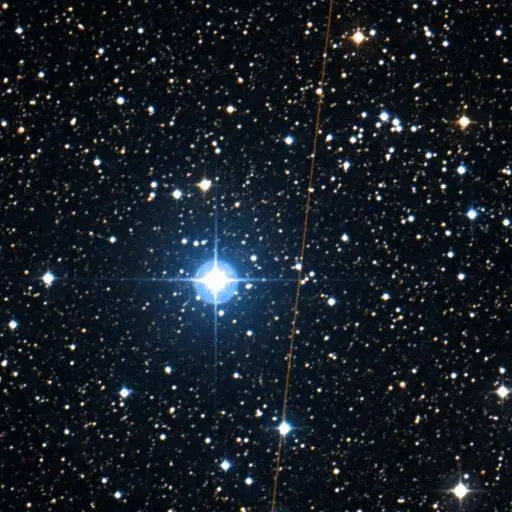
A scattered star family around a fast-spinning blue star, in the constellation of the Little Fox.
Some stars spin so fast they come close to flinging themselves apart. 20 Vulpeculae is one of them: a hot Be star, whirling so quickly that it sheds gas from its equator into a glowing disc around itself. Around it lies NGC 6885, an open cluster in the summer Milky Way.
William Herschel recorded it in 1784. Its catalogue history is tangled: some lists treat it and its neighbour NGC 6882 as one cluster, others as two separate ones.
It lies in Vulpecula, the Little Fox, a constellation created in the late 1600s by the Polish astronomer Johannes Hevelius — who originally drew the fox with a goose in its jaws.
NGC 6885 (NGC 6882) is 5,000 light-years away: the light we see from it set off around 2980 BC, around the time the first circle of Stonehenge was raised.
Did you know?
- Where the goose went. Hevelius called the constellation Vulpecula cum Ansere, the little fox with the goose. The goose has long since flown from the name, but the brightest star, Anser, keeps its memory.
- Next door to the Dumbbell. It lies near M 27, the Dumbbell Nebula — the first planetary nebula ever discovered, found by Charles Messier in 1764.
How big is it?
2.6 times the distance from the Sun to the nearest star. Light itself takes 11 years to cross it. Gaia has picked out 248 stars moving together through space as its members. Shrink our Solar System — the Sun and all eight planets — to the size of a coin, and NGC 6885 would be 275 m across (3 football pitches end to end); the nearest star would be a football pitch away, and the Milky Way 2,520 km across.
A scattered open cluster in Vulpecula around the 6th-magnitude star 20 Vulpeculae.
When and where to see it
It is best placed in the evening sky around August, when it crosses the meridian at about 10 pm local time (around midnight in July). It can be seen from everywhere north of 64°S and never sets north of 64°N.
At its highest it stands 66° up from 50°N, 81° up from 35°N, 64° up from the equator, 29° up from 35°S.
Facts
- Type
- Open cluster
- Constellation
- Vulpecula
- Designations
- NGC 6882, C 37
- Magnitude
- 6.0
- Apparent size
- 7.5′
- Position
- RA 20h 11.9m, Dec +26° 29′ (J2000)
- Distance
- 5,000 light-years
- Discovered
- William Herschel, 1784
Open AstroPilot to see when NGC 6885 (NGC 6882) is highest tonight from your location, how easy it is with your telescope or binoculars, and an eyepiece view.