NGC 6830
NGC 6830 is an open cluster in the constellation Vulpecula, magnitude 7.9, 4.2′ across.
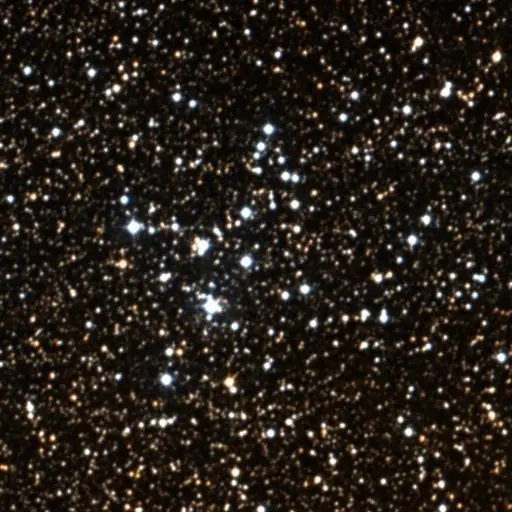
The Poodle Cluster: some 150 stars in the Little Fox, the constellation where the first pulsar was found.
Nicknamed the Poodle Cluster, NGC 6830 is an open cluster of about 150 stars in Vulpecula, the Little Fox. William Herschel found it on 19 July 1784, and his son John observed it again on 12 July 1830.
Its constellation holds a landmark of modern astronomy: the first pulsar ever discovered, found by Jocelyn Bell Burnell in 1967.
NGC 6830 is 7,100 light-years away: the light we see from it set off around 5080 BC, 430 years after the first towns were growing in the Fertile Crescent.
How big is it?
Born about 160 million years ago, when dinosaurs were rising and the supercontinent Pangaea was breaking apart. Light itself takes 8.7 years to cross it. Gaia has picked out 331 stars moving together through space as its members. That’s twice the distance from the Sun to the nearest star. Shrink our Solar System — the Sun and all eight planets — to the size of a coin, and NGC 6830 would be 219 m across (2 football pitches end to end); the nearest star would be a football pitch away, and the Milky Way 2,520 km across.
A 7.9-magnitude open cluster in Vulpecula, about 4.2′ across.
When and where to see it
It is best placed in the evening sky around August, when it crosses the meridian at about 10 pm local time (around midnight in July). It can be seen from everywhere north of 67°S and never sets north of 67°N.
At its highest it stands 63° up from 50°N, 78° up from 35°N, 67° up from the equator, 32° up from 35°S.
Facts
- Type
- Open cluster
- Constellation
- Vulpecula
- Designations
- NGC 6830
- Magnitude
- 7.9
- Apparent size
- 4.2′
- Position
- RA 19h 51.0m, Dec +23° 6′ (J2000)
- Distance
- 7,100 light-years
- Discovered
- William Herschel, 1784
Open AstroPilot to see when NGC 6830 is highest tonight from your location, how easy it is with your telescope or binoculars, and an eyepiece view.