Blinking Planetary (NGC 6826)
Blinking Planetary (NGC 6826) is a planetary nebula in the constellation Cygnus, magnitude 9.4, 25″ across.
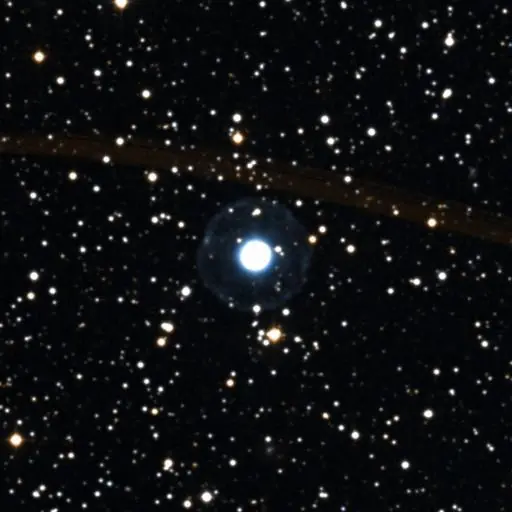
A dying star in a glowing shell, flanked by two mysterious knots racing outward faster than sound.
When a star like the Sun runs out of fuel, it swells into a red giant and gently puffs its outer layers into space. Its exposed, intensely hot core then lights them up from inside. NGC 6826 is caught in exactly that stage: a glowing shell around a hot O-type star, catalogued as HD 186924.
William Herschel found it in 1793. He had coined the term planetary nebula for objects like this, because their small round discs reminded him of a planet — and he knew planets well, having discovered Uranus.
The most curious features are two bright patches on either side, known as FLIERs. They appear to be relatively young, and they are moving outward at supersonic speed.
Blinking Planetary (NGC 6826) is 4,700 light-years away: the light we see from it set off around 2680 BC, around the time the Great Pyramid of Giza was completed.
Did you know?
- What a FLIER is. The name stands for Fast Low-Ionisation Emission Region: a dense knot of gas, travelling outward fast and glowing with less ionised gas than its surroundings.
- Not the only blinker. Its nickname, the Blinking Planetary, comes from a trick of the human eye. Plenty of other planetary nebulae “blink” in just the same way; this one simply got the name.
How big is it?
604 Solar Systems side by side. Light itself takes 7 months to cross it. Shrink our Solar System — the Sun and all eight planets — to the size of a coin, and Blinking Planetary would be 14.5 m across (about the length of a bus); the nearest star would be a football pitch away, and the Milky Way 2,520 km across.
A planetary nebula with a bright central star: look straight at it and the star overwhelms the nebula, glance aside and the nebula returns — hence the 'blink'.
When and where to see it
It is best placed in the evening sky around August, when it crosses the meridian at about 10 pm local time (around midnight in July). It can be seen from everywhere north of 39°S and never sets north of 39°N.
At its highest it stands 89° up from 50°N, 74° up from 35°N, 39° up from the equator, 4° up from 35°S.
Facts
- Type
- Planetary nebula
- Constellation
- Cygnus
- Designations
- NGC 6826, C 15
- Magnitude
- 9.4
- Apparent size
- 25″
- Position
- RA 19h 44.8m, Dec +50° 31′ (J2000)
- Distance
- 4,700 light-years
- Discovered
- William Herschel, 1793
Open AstroPilot to see when Blinking Planetary (NGC 6826) is highest tonight from your location, how easy it is with your telescope or binoculars, and an eyepiece view.