Barnard's Galaxy (NGC 6822)
Barnard's Galaxy (NGC 6822) is a galaxy in the constellation Sagittarius, magnitude 9.4 (blue), 17′ × 17′ across.
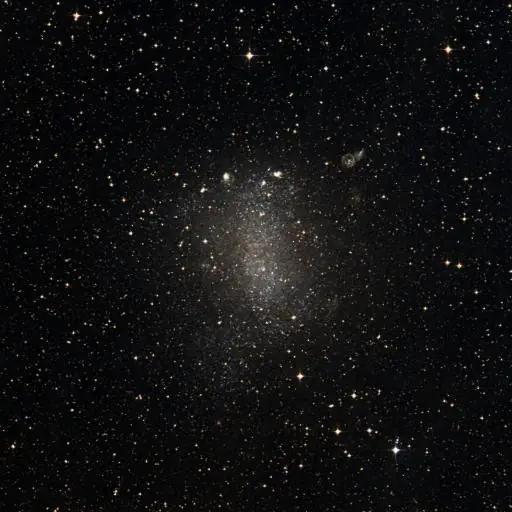
The small galaxy that helped Edwin Hubble show the universe is far bigger than anyone thought.
In 1925 Edwin Hubble published a paper with a modest title: “N.G.C. 6822, a Remote Stellar System”. In this faint smudge in Sagittarius he had found eleven Cepheid variable stars, and their pulsing told him how far away they were. The answer placed it far beyond Harlow Shapley’s estimate for the size of the entire universe.
It was the first system beyond the Magellanic Clouds to have its distance measured, and it helped settle the “Great Debate”: the faint spiral nebulae scattered across the sky turned out to be whole galaxies of their own. Hubble went on to do the same for Andromeda and the Triangulum Galaxy.
Edward Emerson Barnard had discovered it in 1884 with a six-inch refractor. Today we know it as a barred irregular galaxy in the Local Group, much like the Small Magellanic Cloud — and the closest galaxy to us that is not a satellite of the Milky Way.
Barnard's Galaxy (NGC 6822) is 1.5 million light-years away: the light we see from it set off about 1.5 million years ago, when our distant ancestors were making the first stone tools.
Did you know?
- A tilted mystery. Its hydrogen gas lies in a disc, but that disc is tipped at about 60° to the galaxy’s stars — a puzzle astronomers have yet to solve.
- Bubbles and rings. Hubble described its five brightest star-forming clouds, including ones known as the Bubble and the Ring. More than 150 such glowing clouds are now catalogued.
- A brush with our galaxy. NGC 6822 has spent most of its life alone, but it probably passed close to the Milky Way 3 to 4 billion years ago — around the time it began making most of its stars.
How big is it?
A dwarf beside the Milky Way. Light itself takes 7,580 years to cross it. Shrink it to the length of a football pitch and our whole Solar System would be about the size of a red blood cell.
A dwarf irregular galaxy in the Local Group, discovered by E. E. Barnard in 1884; dim and diffuse, it is best at low power under dark skies.
When and where to see it
It is best placed in the evening sky around August, when it crosses the meridian at about 10 pm local time (around midnight in July). It can be seen from everywhere south of 75°N and never sets south of 75°S.
At its highest it stands 25° up from 50°N, 40° up from 35°N, 75° up from the equator, 70° up from 35°S.
Facts
- Type
- Galaxy
- Constellation
- Sagittarius
- Designations
- NGC 6822, IC 4895, C 57
- Magnitude
- 9.4 (blue)
- Apparent size
- 17′ × 17′
- Position
- RA 19h 45.0m, Dec −14° 48′ (J2000)
- Distance
- 1.5 million light-years
- Discovered
- Edward Emerson Barnard, 1884
Open AstroPilot to see when Barnard's Galaxy (NGC 6822) is highest tonight from your location, how easy it is with your telescope or binoculars, and an eyepiece view.