Little Gem Nebula (NGC 6818)
Little Gem Nebula (NGC 6818) is a planetary nebula in the constellation Sagittarius, magnitude 9.3, 46″ across.
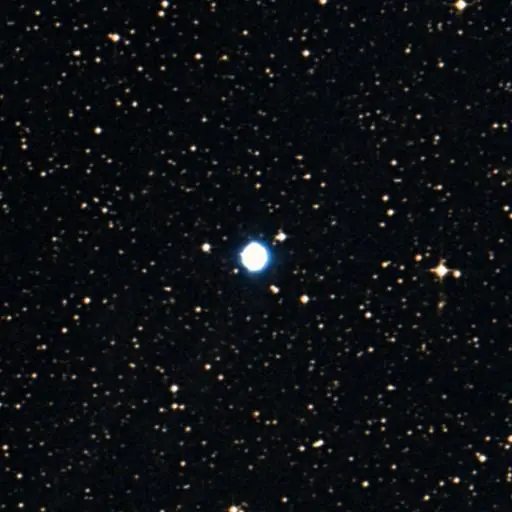
A small, glowing bubble in Sagittarius, blown by the wind of a dying Sun-like star.
When a star like the Sun nears its end, it puffs its outer layers into space. NGC 6818 shows the result: a bright, enclosed bubble of gas inside a larger, fainter cloud, laced with knotty filaments. William Herschel found this planetary nebula in 1787.
A wind streaming from the central star shapes it. As that wind ploughs through slower gas thrown off earlier, it stretches the nebula into an oval and lights up bright spots in the bubble’s outer layers.
Little Gem Nebula (NGC 6818) is 6,700 light-years away: the light we see from it set off around 4680 BC, 830 years after the first towns were growing in the Fertile Crescent.
Did you know?
- One of two Little Gems. NGC 6445, another planetary nebula in Sagittarius, shares the nickname Little Gem.
How big is it?
1,580 Solar Systems side by side. Light itself takes 1.5 years to cross it. Shrink our Solar System — the Sun and all eight planets — to the size of a coin, and the Little Gem Nebula would be 37.9 m across (about the length of an Olympic pool); the nearest star would be a football pitch away, and the Milky Way 2,520 km across.
A 9.3-magnitude planetary nebula in Sagittarius, about 46″ across. Its central star is magnitude 16.9 (B-band).
When and where to see it
It is best placed in the evening sky around August, when it crosses the meridian at about 10 pm local time (around midnight in July). It can be seen from everywhere south of 76°N and never sets south of 76°S.
At its highest it stands 26° up from 50°N, 41° up from 35°N, 76° up from the equator, 69° up from 35°S.
Facts
- Type
- Planetary nebula
- Constellation
- Sagittarius
- Designations
- NGC 6818
- Magnitude
- 9.3
- Apparent size
- 46″
- Position
- RA 19h 44.0m, Dec −14° 9′ (J2000)
- Distance
- 6,700 light-years
- Discovered
- William Herschel, 1787
Open AstroPilot to see when Little Gem Nebula (NGC 6818) is highest tonight from your location, how easy it is with your telescope or binoculars, and an eyepiece view.