NGC 6811
NGC 6811 is an open cluster in the constellation Cygnus, magnitude 6.8, 7.2′ across.
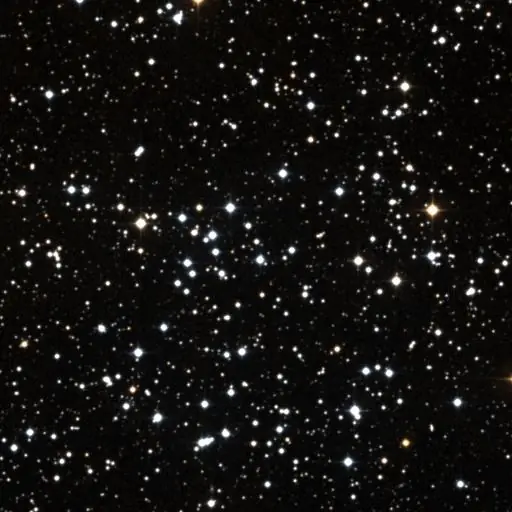
A billion-year-old cluster with a hole in its middle — and the first transiting planets found in an open cluster.
Two stars in NGC 6811 have worlds of their own. NASA’s Kepler mission caught Kepler-66b and Kepler-67b crossing the faces of their Sun-like stars: the first planets smaller than Jupiter, and the first transiting planets, found in an open cluster. Both are smaller than Neptune, and because the cluster is so well measured, they are among the few planets whose age is accurately known.
The cluster is about a billion years old and may have started with some 6,000 stars; a few hundred confirmed members remain. They ring a seemingly empty centre, which earned it the name “Hole in the Cluster”. John Herschel found it in 1829.
NGC 6811 is 3,600 light-years away: the light we see from it set off around 1580 BC, 250 years before Tutankhamun was buried in the Valley of the Kings.
Did you know?
- Planets in a crowd. The discovery suggests planets are about as common in clusters as around lone stars, and can form and survive in surroundings far more crowded than the Sun’s.
- Lost giants. The cluster probably once held 8 O-type and 125 B-type stars — hot, massive suns that have all long since left the main sequence.
How big is it?
Born about 1.1 billion years ago, when there were no animals on Earth at all. Light itself takes 7.5 years to cross it. Gaia has picked out 435 stars moving together through space as its members. That’s 1.8 times the distance from the Sun to the nearest star. Shrink our Solar System — the Sun and all eight planets — to the size of a coin, and NGC 6811 would be 190 m across (2 football pitches end to end); the nearest star would be a football pitch away, and the Milky Way 2,520 km across.
A 6.8-magnitude open cluster in Cygnus, about 7.2′ across.
When and where to see it
It is best placed in the evening sky around August, when it crosses the meridian at about 10 pm local time (around midnight in July). It can be seen from everywhere north of 44°S and never sets north of 44°N.
At its highest it stands 86° up from 50°N, 79° up from 35°N, 44° up from the equator, 9° up from 35°S.
Facts
- Type
- Open cluster
- Constellation
- Cygnus
- Designations
- NGC 6811
- Magnitude
- 6.8
- Apparent size
- 7.2′
- Position
- RA 19h 37.3m, Dec +46° 23′ (J2000)
- Distance
- 3,600 light-years
- Discovered
- John Herschel, 1829
Open AstroPilot to see when NGC 6811 is highest tonight from your location, how easy it is with your telescope or binoculars, and an eyepiece view.