NGC 6791
NGC 6791 is an open cluster in the constellation Lyra, magnitude 9.5, 6.3′ across.
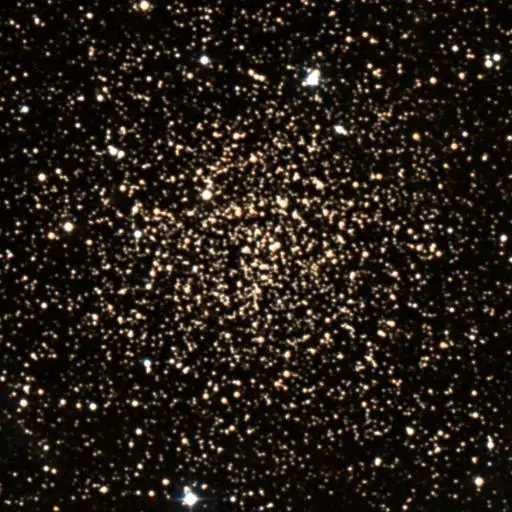
One of the oldest and most metal-rich star clusters in the galaxy — a cluster that breaks the usual rules.
Old usually means poor. The oldest stars formed before the galaxy had built up much iron and other heavy elements, so they contain little of them. NGC 6791 breaks the rule. At roughly 8 billion years old, it is one of the oldest open clusters known, yet its stars hold more than twice the Sun’s share of iron.
Add an unusually large crowd of stars, and it is no surprise that this is one of the most studied clusters in the sky. Friedrich Winnecke found it in 1853.
NGC 6791 is 14,000 light-years away: the light we see from it set off about 14,000 years ago, when the last Ice Age was ending.
Did you know?
- Kepler’s first look. When NASA’s Kepler planet-hunting telescope released its first images in April 2009, NGC 6791 was one of two objects highlighted.
- Out-of-step white dwarfs. Some of its faintest white dwarfs seemed to be only 6 or 4 billion years old, out of step with the cluster’s 8 billion. Astronomers have since proposed a solution that fits an age of about 8 billion years.
How big is it?
Born about 6.3 billion years ago, when there were no animals on Earth at all. Light itself takes 26 years to cross it. Gaia has picked out 4,193 stars moving together through space as its members. That’s 6.1 times the distance from the Sun to the nearest star. Shrink our Solar System — the Sun and all eight planets — to the size of a coin, and NGC 6791 would be 648 m across (6 football pitches end to end); the nearest star would be a football pitch away, and the Milky Way 2,520 km across.
A 9.5-magnitude open cluster in Lyra, about 6.3′ across.
When and where to see it
It is best placed in the evening sky around August, when it crosses the meridian at about 10 pm local time (around midnight in July). It can be seen from everywhere north of 52°S and never sets north of 52°N.
At its highest it stands 78° up from 50°N, 87° up from 35°N, 52° up from the equator, 17° up from 35°S.
Facts
- Type
- Open cluster
- Constellation
- Lyra
- Designations
- NGC 6791
- Magnitude
- 9.5
- Apparent size
- 6.3′
- Position
- RA 19h 20.9m, Dec +37° 46′ (J2000)
- Distance
- 14,000 light-years
- Discovered
- Friedrich Winnecke, 1853
Open AstroPilot to see when NGC 6791 is highest tonight from your location, how easy it is with your telescope or binoculars, and an eyepiece view.