NGC 676
NGC 676 is a galaxy in the constellation Pisces, magnitude 10.2 (blue), 2.8′ × 41″ across.
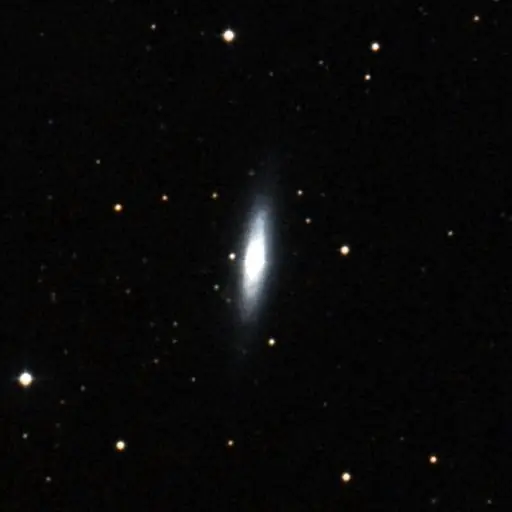
A galaxy with an active heart — and a foreground star photobombing its core.
A star from our own galaxy sits almost on top of NGC 676. The 10th-magnitude star BD +04 244 lies just 5 arcseconds from the galaxy’s nucleus — a chance alignment of a near neighbour with a galaxy far beyond. Behind it, NGC 676 is a lenticular galaxy with a Seyfert nucleus: its core glows brightly as gas falls towards a central black hole.
William Herschel discovered it on 30 September 1786. Marat Arakelian later included it in his catalogue of 621 galaxies with high surface brightness.
NGC 676 is 68 million light-years away: the light we see from it set off about 68 million years ago, when dinosaurs still walked the Earth.
How big is it?
54% of the Milky Way’s width. Light itself takes 54,000 years to cross it. Shrink it to the length of a football pitch and our whole Solar System would be smaller than a bacterium.
A 10.2-magnitude (B-band) lenticular galaxy (S0-a) in Pisces, about 2.8′ × 0.7′.
When and where to see it
It is best placed in the evening sky around November, when it crosses the meridian at about 10 pm local time (around midnight in October). It can be seen from everywhere north of 84°S and never sets north of 84°N.
At its highest it stands 46° up from 50°N, 61° up from 35°N, 84° up from the equator, 49° up from 35°S.
Facts
- Type
- Galaxy
- Constellation
- Pisces
- Designations
- NGC 676
- Magnitude
- 10.2 (blue)
- Apparent size
- 2.8′ × 41″
- Position
- RA 1h 49.0m, Dec +5° 54′ (J2000)
- Distance
- 68 million light-years
- Discovered
- William Herschel, 1786
Open AstroPilot to see when NGC 676 is highest tonight from your location, how easy it is with your telescope or binoculars, and an eyepiece view.