NGC 6744 (C 101)
NGC 6744 (C 101) is a galaxy in the constellation Pavo, magnitude 9.3, 16′ × 9.8′ across.
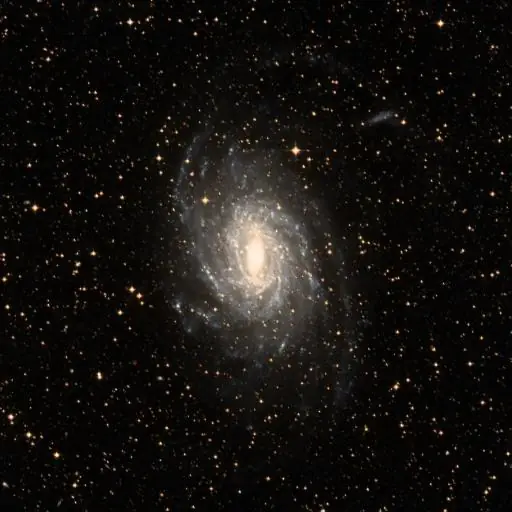
If you could fly out of the Milky Way and look back, you might see something very like this.
We can never photograph the Milky Way from outside: we live inside it. NGC 6744 is the next best thing. It is one of the largest spirals nearby and one of the closest look-alikes of our own galaxy, with an elongated core, fluffy, patchy arms busy with star formation, and even a small, distorted companion that resembles one of our Magellanic Clouds.
James Dunlop found it on 30 June 1826 from Parramatta, in Australia — the same night he found the Great Peacock Globular, nearby in Pavo.
In September 2024 the BlackGEM survey caught a new point of light in the galaxy. At first it looked like an odd nova, but it turned out to be a faint Type Iax supernova — probably the closest of its kind ever seen.
NGC 6744 (C 101) is 29 million light-years away: the light we see from it set off about 29 million years ago, when the Himalayas and the Alps were rising.
Did you know?
- The first supernova. The galaxy’s first recorded supernova, SN 2005at, was found on 15 March 2005 by R. Martin and the South African amateur Berto Monard.
- A quietly active heart. Its nucleus is a mild active galactic nucleus, glowing with the light of weakly ionised gas — far tamer than a quasar, but more than an ordinary core.
- The Pavo Galaxy. It is sometimes called the Pavo Galaxy, after the Peacock, one of the southern constellations added to star maps around 1600 from the observations of Dutch navigators.
How big is it?
1.3 times as wide as our Milky Way. Light itself takes 130,000 years to cross it. Shrink it to the length of a football pitch and our whole Solar System would be smaller than a bacterium. All told — stars, gas and dark matter — it weighs about 59 billion Suns.
A large spiral in Pavo, often compared to the Milky Way; faint and diffuse, it needs dark skies.
When and where to see it
It is best placed in the evening sky around August, when it crosses the meridian at about 10 pm local time (around midnight in July). It can be seen from everywhere south of 26°N and never sets south of 26°S.
At its highest it stands below the horizon from 50°N, below the horizon from 35°N, 26° up from the equator, 61° up from 35°S.
Facts
- Type
- Galaxy
- Constellation
- Pavo
- Designations
- C 101
- Magnitude
- 9.3
- Apparent size
- 16′ × 9.8′
- Position
- RA 19h 9.8m, Dec −63° 51′ (J2000)
- Distance
- 29 million light-years
- Discovered
- James Dunlop, 1826
Open AstroPilot to see when NGC 6744 (C 101) is highest tonight from your location, how easy it is with your telescope or binoculars, and an eyepiece view.