R Coronae Australis Nebula (NGC 6729)
R Coronae Australis Nebula (NGC 6729) is a reflection nebula in the constellation Corona Australis, 2.5′ × 2.0′ across.
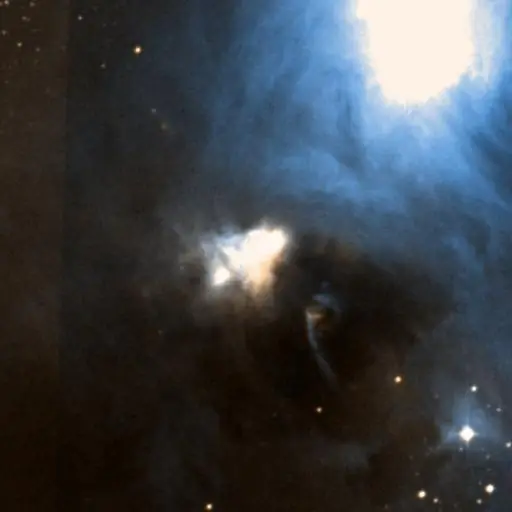
A fan of starlit dust around a star still being born, in one of the nearest stellar nurseries.
Deep in a dark cloud of gas and dust in Corona Australis, a star is still in its infancy. R Coronae Australis has not yet settled down to burning hydrogen steadily in its core, as the Sun does, and its home is one of the closest places where stars are forming today.
Light spilling from the young star bounces off the surrounding dust, painting a glowing fan — a reflection nebula — that opens towards another youngster, T Coronae Australis. Because its star is restless, NGC 6729 is restless too: it is one of the rare variable nebulae, whose look changes over the years.
Johann Friedrich Julius Schmidt, the German astronomer who ran the observatory in Athens, discovered it in 1861.
R Coronae Australis Nebula (NGC 6729) is 420 light-years away: the light we see from it set off around 1605, around the time Galileo first turned a telescope to the sky.
Did you know?
- The Moon mapper. Its discoverer, Julius Schmidt, spent decades drawing the Moon. His great map of the lunar surface, published in 1878, was the most detailed of its day.
- A nursery in the Southern Crown. The dark Corona Australis cloud is still making stars. R CrA and T CrA are two of its youngsters, and infrared telescopes reveal many more hidden in the dust.
How big is it?
321 Solar Systems side by side. Light itself takes 4 months to cross it. Shrink our Solar System — the Sun and all eight planets — to the size of a coin, and the R Coronae Australis Nebula would be 7.7 m across (about the length of a bus); the nearest star would be a football pitch away, and the Milky Way 2,520 km across.
A small, fan-shaped reflection nebula lit by the variable star R Coronae Australis in a dark star-forming cloud; it changes shape and brightness with the star.
When and where to see it
It is best placed in the evening sky around August, when it crosses the meridian at about 10 pm local time (around midnight in July). It can be seen from everywhere south of 53°N and never sets south of 53°S.
At its highest it stands 3° up from 50°N, 18° up from 35°N, 53° up from the equator, 88° up from 35°S.
Facts
- Type
- Reflection nebula
- Constellation
- Corona Australis
- Designations
- NGC 6729, C 68
- Apparent size
- 2.5′ × 2.0′
- Position
- RA 19h 1.9m, Dec −36° 57′ (J2000)
- Distance
- 420 light-years
- Discovered
- Johann Friedrich Julius Schmidt, 1861
Open AstroPilot to see when R Coronae Australis Nebula (NGC 6729) is highest tonight from your location, how easy it is with your telescope or binoculars, and an eyepiece view.