NGC 6684
NGC 6684 is a galaxy in the constellation Pavo, magnitude 10.5, 4.2′ × 3.0′ across.
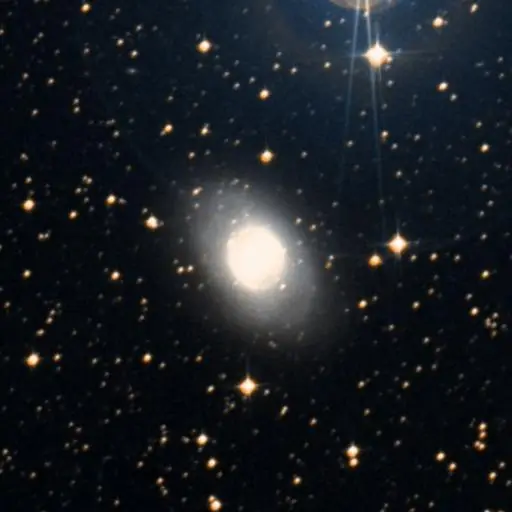
A galaxy far beyond the stars of Pavo, the Peacock, in the deep southern sky.
Pavo, the Peacock, is one of the southern constellations drawn up in the late 1500s from the observations of the Dutch navigators Pieter Dirkszoon Keyser and Frederick de Houtman. Every star you can see in it belongs to our own galaxy. NGC 6684 does not: it is a separate galaxy, a whole island of stars lying far beyond them.
NGC 6684 is 45 million light-years away: the light we see from it set off about 45 million years ago, when mammals were taking over a world without dinosaurs.
How big is it?
55% of the Milky Way’s width. Light itself takes 55,000 years to cross it. Shrink it to the length of a football pitch and our whole Solar System would be smaller than a bacterium.
A 10.5-magnitude lenticular galaxy (S0) in Pavo, about 4.2′ × 3′.
When and where to see it
It is best placed in the evening sky around August, when it crosses the meridian at about 10 pm local time (around midnight in July). It can be seen from everywhere south of 25°N and never sets south of 25°S.
At its highest it stands below the horizon from 50°N, below the horizon from 35°N, 25° up from the equator, 60° up from 35°S.
Facts
- Type
- Galaxy
- Constellation
- Pavo
- Designations
- NGC 6684
- Magnitude
- 10.5
- Apparent size
- 4.2′ × 3.0′
- Position
- RA 18h 49.0m, Dec −65° 10′ (J2000)
- Distance
- 45 million light-years
Open AstroPilot to see when NGC 6684 is highest tonight from your location, how easy it is with your telescope or binoculars, and an eyepiece view.