NGC 6633 (Mel 201)
NGC 6633 (Mel 201) is an open cluster in the constellation Ophiuchus, magnitude 4.6, 20′ across.
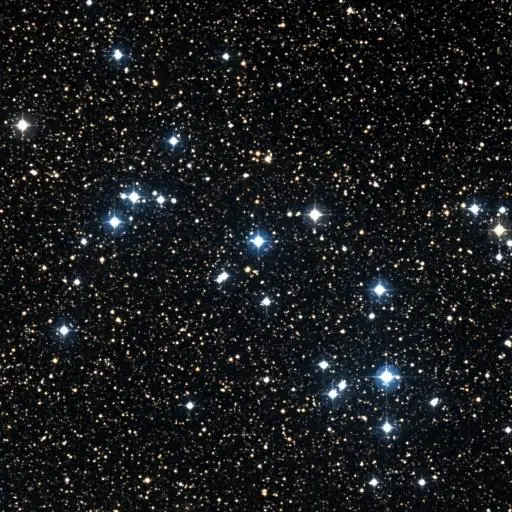
Tweedledum to IC 4756’s Tweedledee: a bright cluster first seen in the 1740s and found again by Caroline Herschel.
Philippe Loys de Chéseaux spotted this cluster in 1745 or 1746. Nearly four decades later Caroline Herschel found it again on her own, and it went into her brother William’s catalogue. Bright enough to glimpse with the naked eye, NGC 6633 is an open cluster about 550 million years old.
It has gathered nicknames: the Wasp, Captain Hook, and — paired with its neighbour IC 4756 — Tweedledum to that cluster’s Tweedledee.
NGC 6633 (Mel 201) is 1,300 light-years away: the light we see from it set off around AD 730, 75 years before Charlemagne was crowned emperor.
Did you know?
- An impostor in the crowd. The eighth-magnitude double star HD 169959 appears to sit among the cluster’s stars, but it only lies along the same line of sight and is not a true member.
How big is it?
Born about 690 million years ago, when there were no animals on Earth at all. Light itself takes 7.6 years to cross it. Gaia has picked out 515 stars moving together through space as its members. That’s 1.8 times the distance from the Sun to the nearest star. Shrink our Solar System — the Sun and all eight planets — to the size of a coin, and NGC 6633 would be 191 m across (2 football pitches end to end); the nearest star would be a football pitch away, and the Milky Way 2,520 km across.
A 4.6-magnitude open cluster in Ophiuchus, about 20′ across.
When and where to see it
It is best placed in the evening sky around July, when it crosses the meridian at about 10 pm local time (around midnight in June). It can be seen from everywhere north of 83°S and never sets north of 83°N.
At its highest it stands 47° up from 50°N, 62° up from 35°N, 83° up from the equator, 48° up from 35°S.
Facts
- Type
- Open cluster
- Constellation
- Ophiuchus
- Designations
- Mel 201, Cr 380, Melotte 201, Collinder 380
- Magnitude
- 4.6
- Apparent size
- 20′
- Position
- RA 18h 27.3m, Dec +6° 30′ (J2000)
- Distance
- 1,300 light-years
- Discovered
- Philippe Loys de Chéseaux, 1745, Found in 1745–46; rediscovered by Caroline Herschel in 1783
Open AstroPilot to see when NGC 6633 (Mel 201) is highest tonight from your location, how easy it is with your telescope or binoculars, and an eyepiece view.