NGC 6604
NGC 6604 is an open cluster in the constellation Serpens, magnitude 6.5, 9.6′ across.
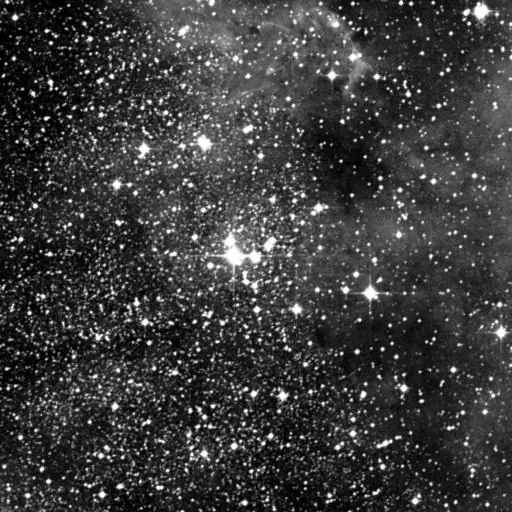
The Eagle Nebula’s young neighbour, home to one of the most luminous stars in the galaxy.
A short hop north of the Eagle Nebula, M 16, NGC 6604 is still busy making stars. Only about 6.5 million years old, this open cluster sits at the heart of a glowing hydrogen cloud, S54, and forms the densest part of a wider family of stars moving together through space. William Herschel found it on 15 July 1784.
Its brightest system, HD 167971, is three massive stars in one. Two of them orbit so tightly that they touch, eclipsing each other as they go. The system ranks among the most luminous in the Milky Way.
NGC 6604 is 6,600 light-years away: the light we see from it set off around 4580 BC, 930 years after the first towns were growing in the Fertile Crescent.
Did you know?
- Colliding winds. HD 168112 is another pair of heavyweights whose fierce winds crash together. It and HD 167971 both shine unusually brightly in X-rays.
How big is it?
4.3 times the distance from the Sun to the nearest star. Light itself takes 18 years to cross it. Gaia has picked out 26 stars moving together through space as its members. Shrink our Solar System — the Sun and all eight planets — to the size of a coin, and NGC 6604 would be 465 m across (4 football pitches end to end); the nearest star would be a football pitch away, and the Milky Way 2,520 km across.
A 6.5-magnitude open cluster in Serpens, about 9.6′ across.
When and where to see it
It is best placed in the evening sky around July, when it crosses the meridian at about 10 pm local time (around midnight in June). It can be seen from everywhere south of 78°N and never sets south of 78°S.
At its highest it stands 28° up from 50°N, 43° up from 35°N, 78° up from the equator, 67° up from 35°S.
Facts
- Type
- Open cluster
- Constellation
- Serpens
- Designations
- NGC 6604
- Magnitude
- 6.5
- Apparent size
- 9.6′
- Position
- RA 18h 18.0m, Dec −12° 15′ (J2000)
- Distance
- 6,600 light-years
- Discovered
- William Herschel, 1784
Open AstroPilot to see when NGC 6604 is highest tonight from your location, how easy it is with your telescope or binoculars, and an eyepiece view.