NGC 6590 (NGC 6595)
NGC 6590 (NGC 6595) is a reflection nebula in the constellation Sagittarius, magnitude 9.8 (blue), 4.0′ × 3.0′ across.
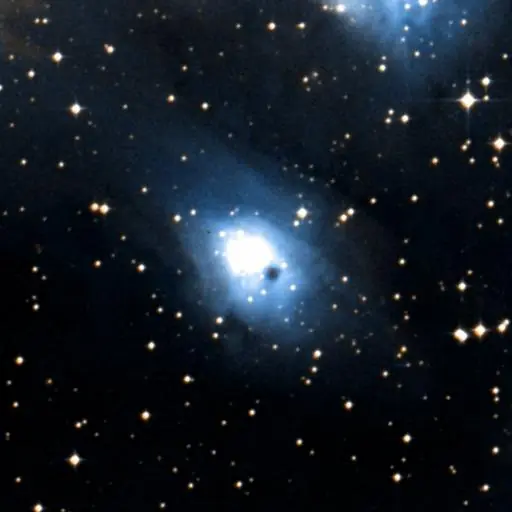
Discovered three times and catalogued under three numbers: a dusty cloud that kept being found anew.
Some objects are hard to keep track of. John Herschel found this reflection nebula on 14 July 1830. Lewis Swift found it again on 12 July 1885, and Edward Barnard a third time in August 1905. Along the way it gathered three catalogue numbers: NGC 6590, NGC 6595 and IC 4700.
It is a cloud of dust lit by nearby stars, scattering their light like haze around a streetlamp. With its neighbour NGC 6589 it sits beside IC 1284, where hydrogen gas glows red, energised by hot young stars.
NGC 6590 (NGC 6595) is 4,100 light-years away: the light we see from it set off around 2080 BC, 490 years after the Great Pyramid of Giza was completed.
How big is it?
About as wide as the distance from the Sun to the nearest star. Light itself takes 4.8 years to cross it. Shrink our Solar System — the Sun and all eight planets — to the size of a coin, and NGC 6590 would be 120 m across (about the length of a football pitch); the nearest star would be a football pitch away, and the Milky Way 2,520 km across.
A 9.8-magnitude (B-band) reflection nebula in Sagittarius, about 4′ × 3′.
When and where to see it
It is best placed in the evening sky around July, when it crosses the meridian at about 10 pm local time (around midnight in June). It can be seen from everywhere south of 70°N and never sets south of 70°S.
At its highest it stands 20° up from 50°N, 35° up from 35°N, 70° up from the equator, 75° up from 35°S.
Facts
- Type
- Reflection nebula
- Constellation
- Sagittarius
- Designations
- NGC 6595, IC 4700
- Magnitude
- 9.8 (blue)
- Apparent size
- 4.0′ × 3.0′
- Position
- RA 18h 17.1m, Dec −19° 52′ (J2000)
- Distance
- 4,100 light-years
- Discovered
- John Herschel, 1830, Found again by Lewis Swift (1885) and Edward Barnard (1905)
Open AstroPilot to see when NGC 6590 (NGC 6595) is highest tonight from your location, how easy it is with your telescope or binoculars, and an eyepiece view.