NGC 6589 (IC 4690)
NGC 6589 (IC 4690) is an emission nebula in the constellation Sagittarius, magnitude 10.5 (blue), 4.0′ × 3.0′ across.
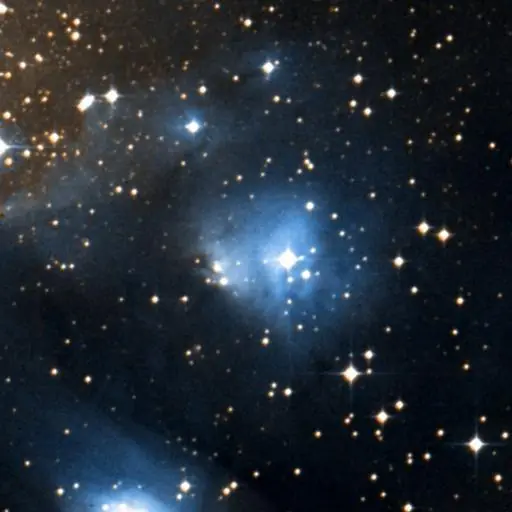
A small blue cloud in Sagittarius, first spotted by a man once famous as a boy for doing sums in his head.
On 28 August 1867 Truman Safford found a faint glow in Sagittarius. As a child he had been famous for working out enormous sums in his head; as an adult he became a professional astronomer. NGC 6589 is a reflection nebula: dust that shines by scattering the light of nearby stars, which gives such clouds their bluish tint.
It has a near twin, the similar nebula NGC 6590, and the pair lie beside the red glow of the emission nebula IC 1284. Edward Barnard listed it again in 1905, so it is also IC 4690.
NGC 6589 (IC 4690) is 4,100 light-years away: the light we see from it set off around 2080 BC, 490 years after the Great Pyramid of Giza was completed.
How big is it?
About as wide as the distance from the Sun to the nearest star. Light itself takes 4.8 years to cross it. Shrink our Solar System — the Sun and all eight planets — to the size of a coin, and NGC 6589 would be 120 m across (about the length of a football pitch); the nearest star would be a football pitch away, and the Milky Way 2,520 km across.
A 10.5-magnitude (B-band) emission nebula in Sagittarius, about 4′ × 3′.
When and where to see it
It is best placed in the evening sky around July, when it crosses the meridian at about 10 pm local time (around midnight in June). It can be seen from everywhere south of 70°N and never sets south of 70°S.
At its highest it stands 20° up from 50°N, 35° up from 35°N, 70° up from the equator, 75° up from 35°S.
Facts
- Type
- Emission nebula
- Constellation
- Sagittarius
- Designations
- IC 4690
- Magnitude
- 10.5 (blue)
- Apparent size
- 4.0′ × 3.0′
- Position
- RA 18h 16.9m, Dec −19° 47′ (J2000)
- Distance
- 4,100 light-years
- Discovered
- Truman Safford, 1867
Open AstroPilot to see when NGC 6589 (IC 4690) is highest tonight from your location, how easy it is with your telescope or binoculars, and an eyepiece view.