NGC 6572
NGC 6572 is a planetary nebula in the constellation Ophiuchus, magnitude 8.1, 11″ across.
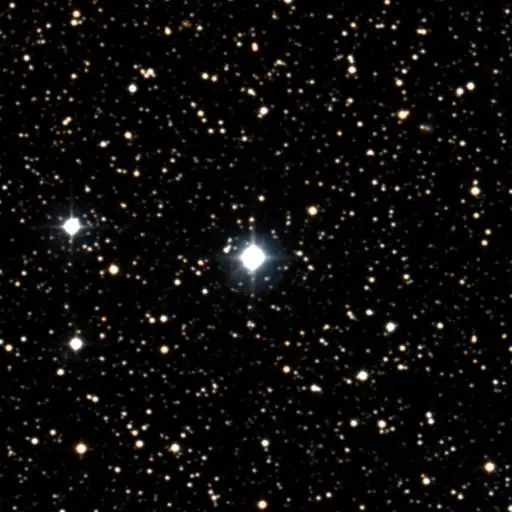
The Emerald Nebula: a young, bright planetary nebula that has only just begun to fade.
Blue Racquetball, Emerald Nebula, Green Nebula, Turquoise Orb: every one of its nicknames is about colour. Friedrich Georg Wilhelm von Struve found NGC 6572 in 1825.
It is a young planetary nebula. Its star began shedding gas only a few thousand years ago, so the shell is still dense and bright. That gas is racing outward at about 15 kilometres per second, and as it thins, the nebula will dim. Inside are two lobed shells, slightly out of line, with a ring of gas round the waist.
NGC 6572 is 5,600 light-years away: the light we see from it set off around 3580 BC, 370 years before writing was invented in Mesopotamia.
Did you know?
- The star at its heart. The central star burns at about 68,000 degrees and shines some 5,700 times brighter than the Sun.
How big is it?
308 Solar Systems side by side. Light itself takes 4 months to cross it. Shrink our Solar System — the Sun and all eight planets — to the size of a coin, and NGC 6572 would be 7.4 m across (about the length of a bus); the nearest star would be a football pitch away, and the Milky Way 2,520 km across.
An 8.1-magnitude planetary nebula in Ophiuchus, about 11″ across. Its central star is magnitude 13.1 (B-band).
When and where to see it
It is best placed in the evening sky around July, when it crosses the meridian at about 10 pm local time (around midnight in June). It can be seen from everywhere north of 83°S and never sets north of 83°N.
At its highest it stands 47° up from 50°N, 62° up from 35°N, 83° up from the equator, 48° up from 35°S.
Facts
- Type
- Planetary nebula
- Constellation
- Ophiuchus
- Designations
- NGC 6572
- Magnitude
- 8.1
- Apparent size
- 11″
- Position
- RA 18h 12.1m, Dec +6° 51′ (J2000)
- Distance
- 5,600 light-years
- Discovered
- Friedrich Georg Wilhelm von Struve, 1825
Open AstroPilot to see when NGC 6572 is highest tonight from your location, how easy it is with your telescope or binoculars, and an eyepiece view.