Cat's Eye Nebula (NGC 6543)
Cat's Eye Nebula (NGC 6543) is a planetary nebula in the constellation Draco, magnitude 9.0, 20″ across.
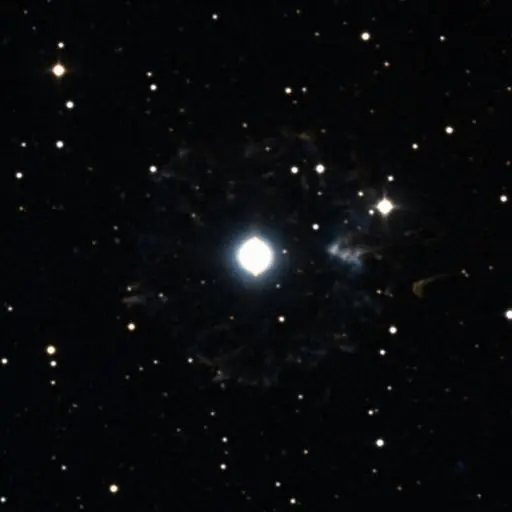
The nebula that proved some nebulae are pure glowing gas — and marks the pole of Earth’s orbit.
On 29 August 1864, William Huggins, an English amateur with an observatory at his London home, pointed a spectroscope at the Cat’s Eye. Starlight would have spread into a continuous rainbow. Instead he saw just a few bright lines — the signature of glowing gas. For the first time, a planetary nebula had been shown to be a cloud of luminous gas, not a swarm of stars.
Today we know what Huggins was looking at. A dying star has been shedding its outer layers in shells, and Hubble’s images reveal knots, jets, bubbles and a dartboard of rings around it. The star is still losing around twenty trillion tonnes of material every second, carried off on a wind racing at about 1,900 kilometres per second.
William Herschel discovered the nebula on 15 February 1786.
Cat's Eye Nebula (NGC 6543) is 3,300 light-years away: the light we see from it set off around 1280 BC, around the time Tutankhamun was buried in the Valley of the Kings.
Did you know?
- Marking the ecliptic pole. The Cat’s Eye lies almost exactly at the north ecliptic pole, the point straight “above” the plane of Earth’s orbit. The celestial pole slowly wanders, but this one barely moves, so the nebula will mark it for all of human history.
- A million-degree bubble. In 2001 the Chandra X-ray Observatory found gas inside the nebula at about 1.7 million degrees, heated where the star’s fast wind slams into material it shed earlier.
- Young, by nebula standards. Measuring how fast the nebula grows between Hubble images suggests its bright inner part is no more than about a thousand years old.
How big is it?
333 Solar Systems side by side. Light itself takes 4 months to cross it. Shrink our Solar System — the Sun and all eight planets — to the size of a coin, and Cat's Eye Nebula would be 8 m across (about the length of a bus); the nearest star would be a football pitch away, and the Milky Way 2,520 km across.
A bright planetary nebula near the north ecliptic pole: a small blue-green oval that takes high magnification well. Hubble images show intricate nested shells.
When and where to see it
It is best placed in the evening sky around July, when it crosses the meridian at about 10 pm local time (around midnight in June). It can be seen from everywhere north of 23°S and never sets north of 23°N.
At its highest it stands 73° up from 50°N, 58° up from 35°N, 23° up from the equator, below the horizon from 35°S.
Facts
- Type
- Planetary nebula
- Constellation
- Draco
- Designations
- NGC 6543, C 6
- Magnitude
- 9.0
- Apparent size
- 20″
- Position
- RA 17h 58.6m, Dec +66° 38′ (J2000)
- Distance
- 3,300 light-years
- Discovered
- William Herschel, 1786
Open AstroPilot to see when Cat's Eye Nebula (NGC 6543) is highest tonight from your location, how easy it is with your telescope or binoculars, and an eyepiece view.