Red Spider Nebula (NGC 6537)
Red Spider Nebula (NGC 6537) is a planetary nebula in the constellation Sagittarius, magnitude 11.6, 10″ across.
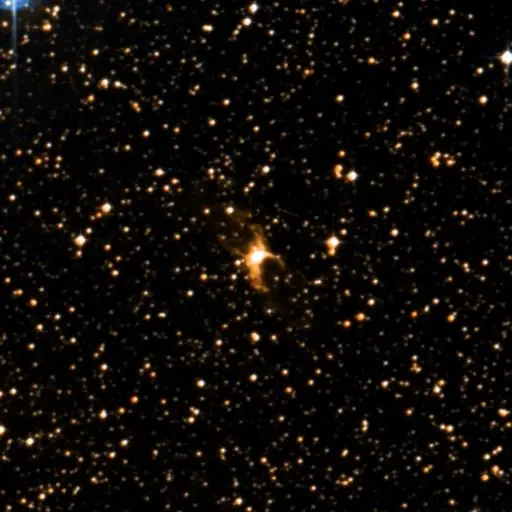
The Red Spider: a dying star so hot and fierce that its winds raise colossal waves in the surrounding gas.
At the heart of the Red Spider lies one of the hottest white dwarfs known. Its surface is probably at 150,000 to 250,000 degrees, and perhaps far hotter. It drives a wind at about 300 kilometres per second, and where that wind slams into slower gas it raises colossal rippling waves. Those shocks shape the nebula’s lobes into the spider’s form.
Edward Pickering found this planetary nebula on 15 July 1882. Hubble and JWST have since found hot dust close to the central star, and the S-shaped twist of the lobes hints that a smaller companion star is stirring things up.
Red Spider Nebula (NGC 6537) is 12,000 light-years away: the light we see from it set off about 12,000 years ago, when the last Ice Age was ending.
Did you know?
- Young lobes. The lobes are expanding so fast that they reached their present size in only about 3,700 years — a blink in the life of a star.
How big is it?
624 Solar Systems side by side. Light itself takes 7 months to cross it. Shrink our Solar System — the Sun and all eight planets — to the size of a coin, and the Red Spider Nebula would be 15 m across (about the length of a bus); the nearest star would be a football pitch away, and the Milky Way 2,520 km across.
An 11.6-magnitude planetary nebula in Sagittarius, about 10″ across. Its central star is magnitude 18.8.
When and where to see it
It is best placed in the evening sky around July, when it crosses the meridian at about 10 pm local time (around midnight in June). It can be seen from everywhere south of 70°N and never sets south of 70°S.
At its highest it stands 20° up from 50°N, 35° up from 35°N, 70° up from the equator, 75° up from 35°S.
Facts
- Type
- Planetary nebula
- Constellation
- Sagittarius
- Designations
- NGC 6537
- Magnitude
- 11.6
- Apparent size
- 10″
- Position
- RA 18h 5.2m, Dec −19° 51′ (J2000)
- Distance
- 12,000 light-years
- Discovered
- Edward Charles Pickering, 1882
Open AstroPilot to see when Red Spider Nebula (NGC 6537) is highest tonight from your location, how easy it is with your telescope or binoculars, and an eyepiece view.