NGC 6503
NGC 6503 is a galaxy in the constellation Draco, magnitude 10.1, 5.9′ × 2.0′ across.
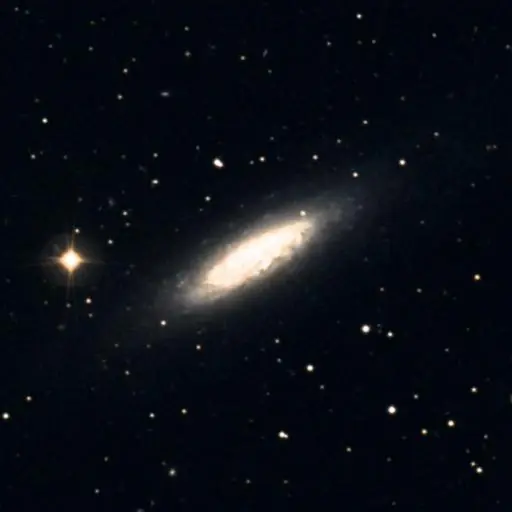
A small spiral galaxy on the shore of the Local Void, one of the emptiest regions near us.
Most galaxies live in groups and clusters. NGC 6503 lives on the edge of nothing. It sits at the border of the Local Void, a vast, nearly empty region of space, and may mark the far tip of a long chain of galaxies reaching out into it.
It is a dwarf spiral galaxy, tilted almost edge-on to us. A ring of young stars circles its centre, perhaps around a bar seen end-on, and its hydrogen gas spreads well beyond the visible disc. Arthur von Auwers found it on 22 July 1854.
NGC 6503 is 17 million light-years away: the light we see from it set off about 17 million years ago, when great apes were spreading through Africa and Europe.
Did you know?
- A single companion. Its one known satellite, KK 242, holds about three million suns’ worth of stars. It sits on the border between two kinds of dwarf galaxy: irregular and spheroidal.
How big is it?
29% of the Milky Way’s width. Light itself takes 29,000 years to cross it. Shrink it to the length of a football pitch and our whole Solar System would be about the size of a red blood cell.
A 10.1-magnitude spiral galaxy (Sc) in Draco, about 5.9′ × 2′.
When and where to see it
It is best placed in the evening sky around July, when it crosses the meridian at about 10 pm local time (around midnight in June). It can be seen from everywhere north of 20°S and never sets north of 20°N.
At its highest it stands 70° up from 50°N, 55° up from 35°N, 20° up from the equator, below the horizon from 35°S.
Facts
- Type
- Galaxy
- Constellation
- Draco
- Designations
- NGC 6503
- Magnitude
- 10.1
- Apparent size
- 5.9′ × 2.0′
- Position
- RA 17h 49.4m, Dec +70° 9′ (J2000)
- Distance
- 17 million light-years
- Discovered
- Arthur von Auwers, 1854
Open AstroPilot to see when NGC 6503 is highest tonight from your location, how easy it is with your telescope or binoculars, and an eyepiece view.