Little Gem (NGC 6445)
Little Gem (NGC 6445) is a planetary nebula in the constellation Sagittarius, magnitude 11.2, 33″ across.
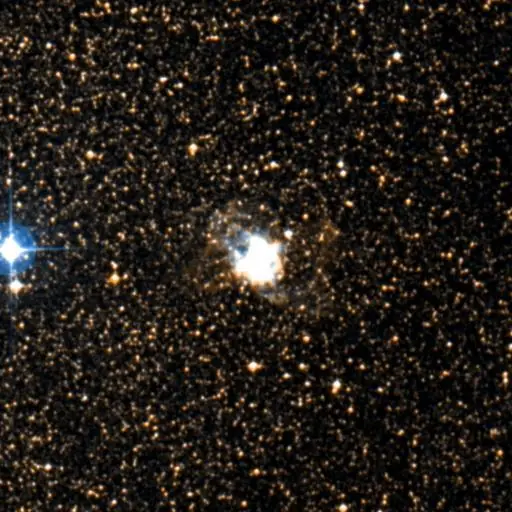
A boxy planetary nebula, one of the largest known — and not the only Little Gem in the sky.
A dying star does not always leave a neat ring. NGC 6445, also called the Box Nebula, has a bright inner ring with open lobes flaring out on either side: a bipolar planetary nebula, and one of the largest known.
Its gas is rich in helium and nitrogen, a sign that the star which shed it was more massive than most. William Herschel found it on 28 May 1786, the same night as the globular cluster NGC 6440, which lies just to the south.
Little Gem (NGC 6445) is 4,700 light-years away: the light we see from it set off around 2680 BC, around the time the Great Pyramid of Giza was completed.
Did you know?
- Two Little Gems. NGC 6818, also in Sagittarius, goes by the same nickname. Both are planetary nebulae, so the name can cause confusion.
How big is it?
791 Solar Systems side by side. Light itself takes 9 months to cross it. Shrink our Solar System — the Sun and all eight planets — to the size of a coin, and Little Gem would be 19 m across (about the length of a tennis court); the nearest star would be a football pitch away, and the Milky Way 2,520 km across.
An 11.2-magnitude planetary nebula in Sagittarius, about 33″ across. Its central star is magnitude 19.
When and where to see it
It is best placed in the evening sky around July, when it crosses the meridian at about 10 pm local time (around midnight in June). It can be seen from everywhere south of 70°N and never sets south of 70°S.
At its highest it stands 20° up from 50°N, 35° up from 35°N, 70° up from the equator, 75° up from 35°S.
Facts
- Type
- Planetary nebula
- Constellation
- Sagittarius
- Designations
- NGC 6445
- Magnitude
- 11.2
- Apparent size
- 33″
- Position
- RA 17h 49.3m, Dec −20° 1′ (J2000)
- Distance
- 4,700 light-years
- Discovered
- William Herschel, 1786
Open AstroPilot to see when Little Gem (NGC 6445) is highest tonight from your location, how easy it is with your telescope or binoculars, and an eyepiece view.