NGC 637
NGC 637 is an open cluster in the constellation Cassiopeia, magnitude 8.2, 4.5′ across.
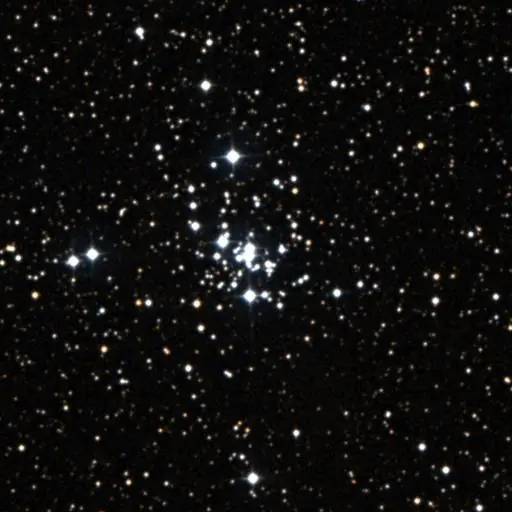
A young, compact cluster unusually rich in pulsating stars — and with a puzzling gap among its stars.
Five of the seven brightest stars in NGC 637 change in brightness. This compact young open cluster, only 5 to 15 million years old, holds four β Cephei stars — hot, massive stars that pulse over a matter of hours — one of the highest counts known for any open cluster. William Herschel discovered it on 9 November 1787.
It also holds a puzzle. Plotted by colour and brightness, its stars show a gap along the main sequence, the band where ordinary stars lie, and missing data does not explain it.
NGC 637 is 8,600 light-years away: the light we see from it set off around 6580 BC, 1,070 years before the first towns were growing in the Fertile Crescent.
How big is it?
Born about 38 million years ago, when the Himalayas and the Alps were rising. Light itself takes 11 years to cross it. Gaia has picked out 175 stars moving together through space as its members. That’s 2.7 times the distance from the Sun to the nearest star. Shrink our Solar System — the Sun and all eight planets — to the size of a coin, and NGC 637 would be 284 m across (3 football pitches end to end); the nearest star would be a football pitch away, and the Milky Way 2,520 km across.
An 8.2-magnitude open cluster in Cassiopeia, about 4.5′ across.
When and where to see it
It is best placed in the evening sky around November, when it crosses the meridian at about 10 pm local time (around midnight in October). It can be seen from everywhere north of 26°S and never sets north of 26°N.
At its highest it stands 76° up from 50°N, 61° up from 35°N, 26° up from the equator, below the horizon from 35°S.
Facts
- Type
- Open cluster
- Constellation
- Cassiopeia
- Designations
- NGC 637
- Magnitude
- 8.2
- Apparent size
- 4.5′
- Position
- RA 1h 43.1m, Dec +64° 2′ (J2000)
- Distance
- 8,600 light-years
- Discovered
- William Herschel, 1787
Open AstroPilot to see when NGC 637 is highest tonight from your location, how easy it is with your telescope or binoculars, and an eyepiece view.