War and Peace Nebula (NGC 6357)
War and Peace Nebula (NGC 6357) is a cluster + nebula in the constellation Scorpius, 50′ across.
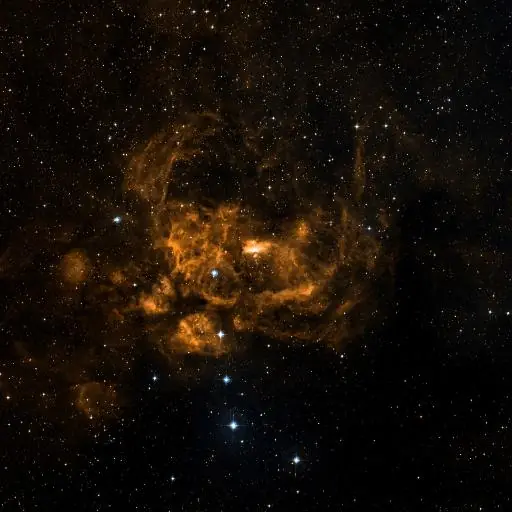
A star factory with a dove at one end and a skull at the other — home to some of the galaxy’s heaviest stars.
Scientists working on the Midcourse Space Experiment looked at this cloud in infrared light and saw two pictures in one. The bright western part resembled a dove; the eastern part, a skull. They called it the War and Peace Nebula. Others know it as the Lobster Nebula.
Inside this glowing cloud is one of the busiest sites of massive-star birth in our part of the Milky Way. Hot O-type stars blow bubbles in the gas, while young stars lie wrapped in expanding cocoons of gas. A thread of gas links it to the Cat’s Paw Nebula, NGC 6334, and the two may form one vast complex.
War and Peace Nebula (NGC 6357) is 5,500 light-years away: the light we see from it set off around 3480 BC, 270 years before writing was invented in Mesopotamia.
Did you know?
- Not quite the heaviest star. Pismis 24-1, in the nebula’s cluster Pismis 24, was once thought to be perhaps the most massive star known, close to 300 times the Sun’s mass. It turned out to be at least three stars — each still around 100 solar masses.
- Hidden crowds. Chandra’s X-ray images revealed two more young clusters beside Pismis 24, each with roughly 800 stars.
- The rename that failed. In 2013 a petition with 19,000 signatures asked for it to be renamed the “Madokami Nebula”, after an anime heroine it was said to resemble. The name did not stick.
How big is it?
19 times the distance from the Sun to the nearest star. Light itself takes 80 years to cross it. Gaia has picked out 152 stars moving together through space as its members. Shrink our Solar System — the Sun and all eight planets — to the size of a coin, and the War and Peace Nebula would be 2.02 km across (a 25-minute walk); the nearest star would be a football pitch away, and the Milky Way 2,520 km across.
A star cluster with nebulosity in Scorpius, about 50′ across.
When and where to see it
It is best placed in the evening sky around July, when it crosses the meridian at about 10 pm local time (around midnight in June). It can be seen from everywhere south of 56°N and never sets south of 56°S.
At its highest it stands 6° up from 50°N, 21° up from 35°N, 56° up from the equator, 89° up from 35°S.
Facts
- Type
- Cluster + nebula
- Constellation
- Scorpius
- Designations
- NGC 6357
- Apparent size
- 50′
- Position
- RA 17h 24.7m, Dec −34° 12′ (J2000)
- Distance
- 5,500 light-years
- Discovered
- John Herschel, 1837
Open AstroPilot to see when War and Peace Nebula (NGC 6357) is highest tonight from your location, how easy it is with your telescope or binoculars, and an eyepiece view.