Box Nebula (NGC 6309)
Box Nebula (NGC 6309) is a planetary nebula in the constellation Ophiuchus, magnitude 11.5, 16″ across.
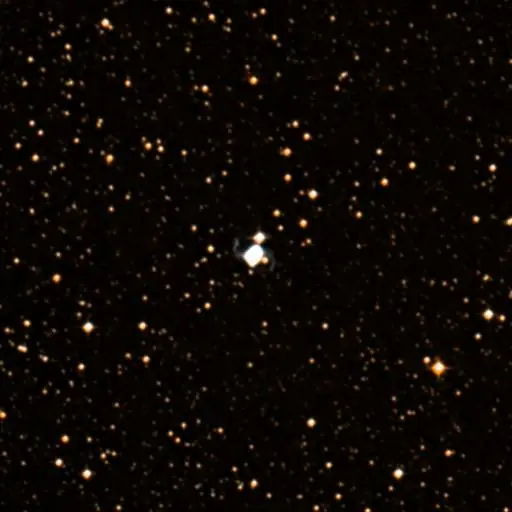
A dying star that blew out two pairs of lobes, giving its nebula a square-cut, boxy look.
Many planetary nebulae are round, or stretched along a single axis. NGC 6309 has two: two pairs of lobes point in different directions, wrapped inside a round outer shell that formed first. Together they give it a square-cut shape and its names, the Box Nebula and the Exclamation Mark Nebula. Its hot central star has a helium-rich atmosphere and shines about 1,800 times as brightly as the Sun.
Box Nebula (NGC 6309) is 9,000 light-years away: the light we see from it set off around 6980 BC, 1,470 years before the first towns were growing in the Fertile Crescent.
Did you know?
- Found by a comet hunter. Wilhelm Tempel discovered it in 1876. He is best remembered for comets: one of his finds, Comet Tempel–Tuttle, is the parent of the Leonid meteor shower.
How big is it?
716 Solar Systems side by side. Light itself takes 8 months to cross it. Shrink our Solar System — the Sun and all eight planets — to the size of a coin, and the Box Nebula would be 17.2 m across (about the length of a bus); the nearest star would be a football pitch away, and the Milky Way 2,520 km across.
An 11.5-magnitude planetary nebula in Ophiuchus, about 16″ across. Its central star is magnitude 16.6 (B-band).
When and where to see it
It is best placed in the evening sky around July, when it crosses the meridian at about 10 pm local time (around midnight in June). It can be seen from everywhere south of 77°N and never sets south of 77°S.
At its highest it stands 27° up from 50°N, 42° up from 35°N, 77° up from the equator, 68° up from 35°S.
Facts
- Type
- Planetary nebula
- Constellation
- Ophiuchus
- Designations
- NGC 6309
- Magnitude
- 11.5
- Apparent size
- 16″
- Position
- RA 17h 14.1m, Dec −12° 55′ (J2000)
- Distance
- 9,000 light-years
- Discovered
- Wilhelm Tempel, 1876
Open AstroPilot to see when Box Nebula (NGC 6309) is highest tonight from your location, how easy it is with your telescope or binoculars, and an eyepiece view.