Bug Nebula (NGC 6302)
Bug Nebula (NGC 6302) is a planetary nebula in the constellation Scorpius, magnitude 9.6, 44″ across.
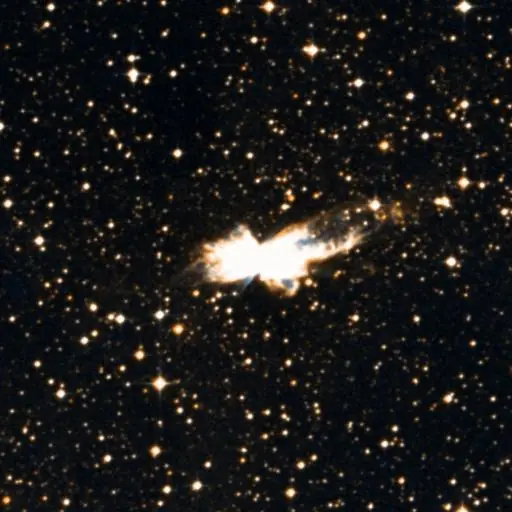
A dying star so hot it hid from Hubble, wrapped in a dusty belt and flinging out wings of gas.
Two glowing wings burst from a dark, dusty waist. NGC 6302 — the Bug, or the Butterfly — is a planetary nebula with one of the most complex shapes ever seen. At the tip of one wing, gas rushes outward at more than 600 kilometres per second: fast enough to cross from Earth to the Moon in about eleven minutes.
The star behind it all was once about five times the mass of the Sun. Having cast off most of itself, it is now a white dwarf in the making, with a surface hotter than 200,000 degrees — among the hottest stars known. For years it stayed hidden: it shines mostly in ultraviolet, and a thick belt of dust blocks the view. Hubble’s new Wide Field Camera 3 finally caught it in 2009.
That belt is strange stuff. It holds crystalline silicates, water ice and quartz — and perhaps carbonates, minerals that on Earth usually form in water, though that claim is still disputed.
Bug Nebula (NGC 6302) is 2,400 light-years away: the light we see from it set off around 380 BC, around the time the Parthenon was dedicated in Athens.
Did you know?
- Fading by the year. Its nuclear fires have gone out. The central star is predicted to fade by about one per cent every year as it cools towards a white dwarf.
- An eruption in Roman times. The nebula’s bright north-west lobe seems to have been blown out in an eruption about 1,900 years ago — roughly when Hadrian ruled Rome.
- Hubble’s comeback picture. After astronauts repaired and upgraded Hubble in 2009, the Bug Nebula was among the first images released to show what the refreshed telescope could do.
How big is it?
543 Solar Systems side by side. Light itself takes 6 months to cross it. Shrink our Solar System — the Sun and all eight planets — to the size of a coin, and the Bug Nebula would be 13 m across (about the length of a bus); the nearest star would be a football pitch away, and the Milky Way 2,520 km across.
A bright, bipolar planetary nebula in Scorpius with one of the hottest known central stars; telescopes show an elongated bar of light.
When and where to see it
It is best placed in the evening sky around July, when it crosses the meridian at about 10 pm local time (around midnight in June). It can be seen from everywhere south of 53°N and never sets south of 53°S.
At its highest it stands 3° up from 50°N, 18° up from 35°N, 53° up from the equator, 88° up from 35°S.
Facts
- Type
- Planetary nebula
- Constellation
- Scorpius
- Designations
- NGC 6302, C 69, Butterfly Nebula
- Magnitude
- 9.6
- Apparent size
- 44″
- Position
- RA 17h 13.7m, Dec −37° 6′ (J2000)
- Distance
- 2,400 light-years
- Discovered
- Edward Emerson Barnard, 1880
Open AstroPilot to see when Bug Nebula (NGC 6302) is highest tonight from your location, how easy it is with your telescope or binoculars, and an eyepiece view.