NGC 6300
NGC 6300 is a galaxy in the constellation Ara, magnitude 10.3, 5.3′ × 3.4′ across.
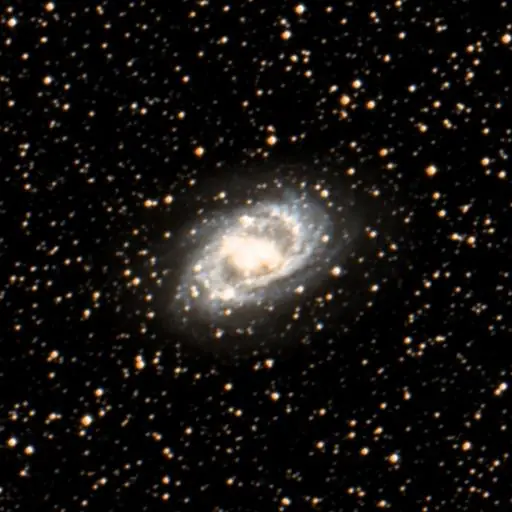
A barred spiral in Ara with an X-ray-bright heart, fed by a central black hole.
At the centre of NGC 6300, gas falling towards a black hole heats up and pours out X-rays. That active core makes this barred spiral galaxy a Seyfert galaxy, and its black hole is thought to be fairly modest — about 300,000 times the Sun’s mass, against the millions or billions found in many other galaxies. James Dunlop discovered it on 30 June 1826, from Parramatta in New South Wales.
NGC 6300 is 42 million light-years away: the light we see from it set off about 42 million years ago, when mammals were taking over a world without dinosaurs.
How big is it?
65% of the Milky Way’s width. Light itself takes 65,000 years to cross it. Shrink it to the length of a football pitch and our whole Solar System would be smaller than a bacterium.
A 10.3-magnitude barred spiral galaxy (SBb) in Ara, about 5.3′ × 3.4′.
When and where to see it
It is best placed in the evening sky around July, when it crosses the meridian at about 10 pm local time (around midnight in June). It can be seen from everywhere south of 27°N and never sets south of 27°S.
At its highest it stands below the horizon from 50°N, below the horizon from 35°N, 27° up from the equator, 62° up from 35°S.
Facts
- Type
- Galaxy
- Constellation
- Ara
- Designations
- NGC 6300
- Magnitude
- 10.3
- Apparent size
- 5.3′ × 3.4′
- Position
- RA 17h 17.0m, Dec −62° 49′ (J2000)
- Distance
- 42 million light-years
- Discovered
- James Dunlop, 1826
Open AstroPilot to see when NGC 6300 is highest tonight from your location, how easy it is with your telescope or binoculars, and an eyepiece view.