NGC 6250
NGC 6250 is a cluster + nebula in the constellation Ara, magnitude 5.9, 9.6′ across.
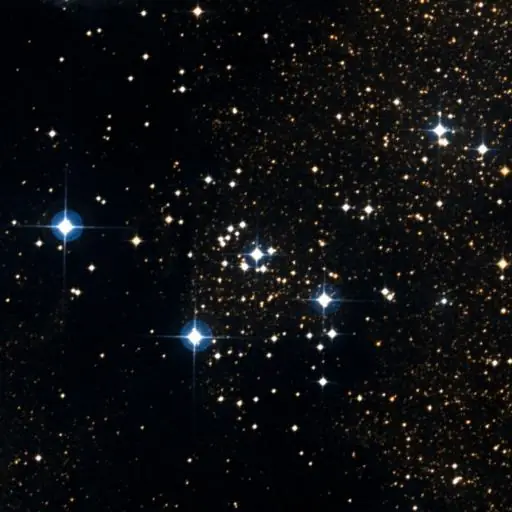
A young cluster whose hot blue stars still light up nearby wisps of dust.
At just 14 million years old, NGC 6250 is young enough that three of its seven hot B-type stars still light up nearby clouds of dust as reflection nebulae. It also holds some chemical oddities: two magnetic stars with peculiar surface chemistry, and two candidate Lambda Boötis stars, whose surfaces are strangely poor in heavy elements. John Herschel discovered it on 1 July 1834.
NGC 6250 is 3,100 light-years away: the light we see from it set off around 1080 BC, 250 years after Tutankhamun was buried in the Valley of the Kings.
How big is it?
Born about 24 million years ago, when the Himalayas and the Alps were rising. Light itself takes 8.7 years to cross it. Gaia has picked out 176 stars moving together through space as its members. That’s twice the distance from the Sun to the nearest star. Shrink our Solar System — the Sun and all eight planets — to the size of a coin, and NGC 6250 would be 218 m across (2 football pitches end to end); the nearest star would be a football pitch away, and the Milky Way 2,520 km across.
A star cluster with nebulosity in Ara, about 9.6′ across. Its catalogued magnitude, 5.9, is that of the star cluster; the nebulosity is much fainter.
When and where to see it
It is best placed in the evening sky around July, when it crosses the meridian at about 10 pm local time (around midnight in June). It can be seen from everywhere south of 44°N and never sets south of 44°S.
At its highest it stands below the horizon from 50°N, 9° up from 35°N, 44° up from the equator, 79° up from 35°S.
Facts
- Type
- Cluster + nebula
- Constellation
- Ara
- Designations
- NGC 6250
- Magnitude
- 5.9
- Apparent size
- 9.6′
- Position
- RA 16h 57.9m, Dec −45° 56′ (J2000)
- Distance
- 3,100 light-years
- Discovered
- John Herschel, 1834
Open AstroPilot to see when NGC 6250 is highest tonight from your location, how easy it is with your telescope or binoculars, and an eyepiece view.