NGC 6249
NGC 6249 is an open cluster in the constellation Scorpius, magnitude 8.2, 7.6′ across.
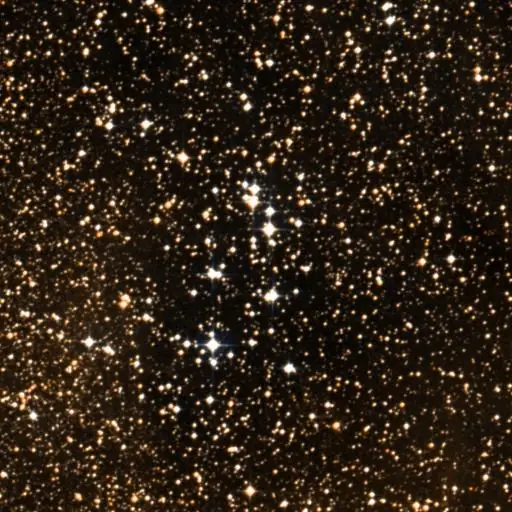
A group of sibling stars in Scorpius, still travelling together through the Galaxy.
Stars are rarely born alone. Most form in groups inside great clouds of gas, and NGC 6249, in Scorpius, is one such group that has stayed together: an open cluster of siblings that share a birthday. In time the Galaxy’s pull will scatter them, as it scattered the cluster in which the Sun was probably born.
NGC 6249 is 3,800 light-years away: the light we see from it set off around 1780 BC, 450 years before Tutankhamun was buried in the Valley of the Kings.
How big is it?
Born about 20 million years ago, when the Himalayas and the Alps were rising. Light itself takes 8.4 years to cross it. Gaia has picked out 114 stars moving together through space as its members. That’s twice the distance from the Sun to the nearest star. Shrink our Solar System — the Sun and all eight planets — to the size of a coin, and NGC 6249 would be 212 m across (2 football pitches end to end); the nearest star would be a football pitch away, and the Milky Way 2,520 km across.
An 8.2-magnitude open cluster in Scorpius, about 7.6′ across.
When and where to see it
It is best placed in the evening sky around July, when it crosses the meridian at about 10 pm local time (around midnight in June). It can be seen from everywhere south of 45°N and never sets south of 45°S.
At its highest it stands below the horizon from 50°N, 10° up from 35°N, 45° up from the equator, 80° up from 35°S.
Facts
- Type
- Open cluster
- Constellation
- Scorpius
- Designations
- NGC 6249
- Magnitude
- 8.2
- Apparent size
- 7.6′
- Position
- RA 16h 57.7m, Dec −44° 49′ (J2000)
- Distance
- 3,800 light-years
Open AstroPilot to see when NGC 6249 is highest tonight from your location, how easy it is with your telescope or binoculars, and an eyepiece view.