NGC 6242 (Mel 155)
NGC 6242 (Mel 155) is an open cluster in the constellation Scorpius, magnitude 6.4, 6.6′ across.
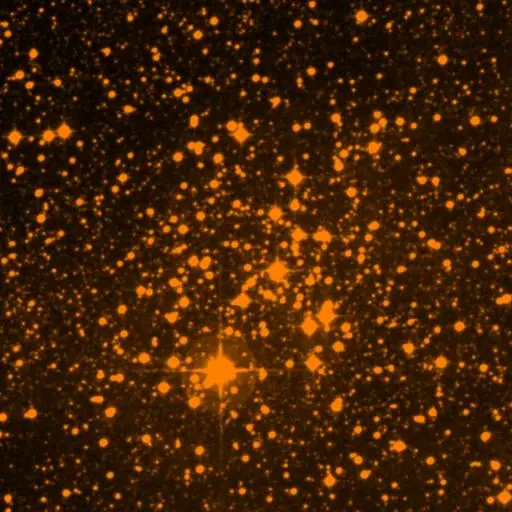
A star cluster that may have flung a black hole into space in a supernova 220,000 years ago.
Racing away from NGC 6242 at about 112 kilometres per second is GRO J1655-40, a microquasar: a black hole feeding on a companion star and firing out jets. Its motion suggests it was born in this cluster and kicked out by a supernova explosion some 220,000 years ago. The open cluster itself is about 78 million years old. Nicolas Louis de Lacaille discovered it in 1752, from the Cape of Good Hope.
NGC 6242 (Mel 155) is 4,000 light-years away: the light we see from it set off around 1980 BC, 590 years after the Great Pyramid of Giza was completed.
How big is it?
Born about 78 million years ago, when dinosaurs still walked the Earth. Light itself takes 7.7 years to cross it. Gaia has picked out 786 stars moving together through space as its members. That’s 1.8 times the distance from the Sun to the nearest star. Shrink our Solar System — the Sun and all eight planets — to the size of a coin, and NGC 6242 would be 194 m across (2 football pitches end to end); the nearest star would be a football pitch away, and the Milky Way 2,520 km across.
A 6.4-magnitude open cluster in Scorpius, about 6.6′ across.
When and where to see it
It is best placed in the evening sky around July, when it crosses the meridian at about 10 pm local time (around midnight in June). It can be seen from everywhere south of 51°N and never sets south of 51°S.
At its highest it stands 1° up from 50°N, 16° up from 35°N, 51° up from the equator, 86° up from 35°S.
Facts
- Type
- Open cluster
- Constellation
- Scorpius
- Designations
- Mel 155, Cr 317, Melotte 155, Collinder 317
- Magnitude
- 6.4
- Apparent size
- 6.6′
- Position
- RA 16h 55.6m, Dec −39° 28′ (J2000)
- Distance
- 4,000 light-years
- Discovered
- Nicolas Louis de Lacaille, 1752
Open AstroPilot to see when NGC 6242 (Mel 155) is highest tonight from your location, how easy it is with your telescope or binoculars, and an eyepiece view.