NGC 6231 (C 76)
NGC 6231 (C 76) is an open cluster in the constellation Scorpius, magnitude 2.6, 14′ across.
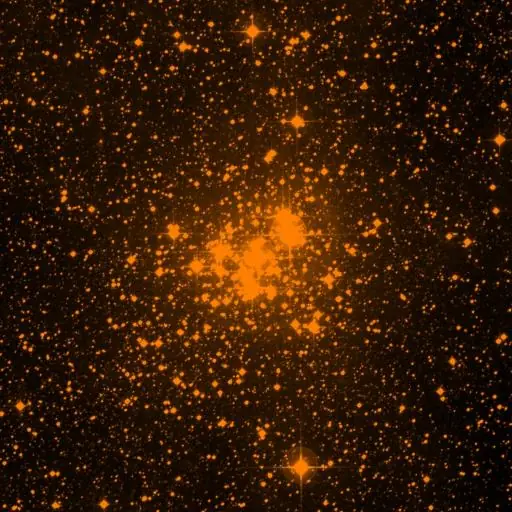
The head of a false comet in Scorpius — a cluster of blazing young giants, among the most luminous stars known.
Low in the curl of the Scorpion’s tail, a little knot of stars looks like the head of a comet, with a faint tail streaming northward. Observers call it the False Comet. The head is NGC 6231, a young open cluster; the tail is a trail of other young clusters, fanning out where the Prawn Nebula glows.
The stars in that head are babies, just 2 to 7 million years old, and some are giants. Zeta¹ Scorpii, part of the same wider family, is one of the most luminous stars known in our galaxy. Its naked-eye partner, Zeta², only looks brighter because it is a near neighbour of ours: the pairing is a trick of perspective.
Giovanni Battista Hodierna recorded the cluster before 1654, calling it Luminosae in a book published that year in Palermo. Edmond Halley found it again in 1678, and Lacaille saw it from the Cape in 1751–52.
NGC 6231 (C 76) is 5,100 light-years away: the light we see from it set off around 3080 BC, around the time the first circle of Stonehenge was raised.
Did you know?
- The Northern Jewel Box. Some call it the Northern Jewel Box, for its likeness to NGC 4755, the Jewel Box in Crux — even though it is itself a southern cluster, just a little less far south.
- A dressing room in the sky. In Chinese astronomy this patch is usually identified with Shengong, a dressing room — though older sources pin the name on faint stars nearby.
- Twins are common. NGC 6231 was used to count how often B-type stars come in pairs: about half of them do. That is common, but not as common as among the even heavier O-type stars. The cluster also holds three rare Wolf–Rayet stars.
How big is it?
Born about 14 million years ago, when great apes were spreading through Africa and Europe. Light itself takes 20 years to cross it. Gaia has picked out 646 stars moving together through space as its members. That’s 4.8 times the distance from the Sun to the nearest star. Shrink our Solar System — the Sun and all eight planets — to the size of a coin, and NGC 6231 would be 517 m across (5 football pitches end to end); the nearest star would be a football pitch away, and the Milky Way 2,520 km across.
A brilliant young open cluster just north of Zeta Scorpii, full of hot blue-white stars.
When and where to see it
It is best placed in the evening sky around July, when it crosses the meridian at about 10 pm local time (around midnight in June). It can be seen from everywhere south of 48°N and never sets south of 48°S.
At its highest it stands below the horizon from 50°N, 13° up from 35°N, 48° up from the equator, 83° up from 35°S.
Facts
- Type
- Open cluster
- Constellation
- Scorpius
- Designations
- C 76, Mel 153, Cr 315, Melotte 153, Collinder 315
- Magnitude
- 2.6
- Apparent size
- 14′
- Position
- RA 16h 54.2m, Dec −41° 49′ (J2000)
- Distance
- 5,100 light-years
- Discovered
- Giovanni Battista Hodierna, 1654, Recorded before 1654 as “Luminosae”; seen again by Halley in 1678
Open AstroPilot to see when NGC 6231 (C 76) is highest tonight from your location, how easy it is with your telescope or binoculars, and an eyepiece view.