NGC 6210
NGC 6210 is a planetary nebula in the constellation Hercules, magnitude 9.7, 30″ across.
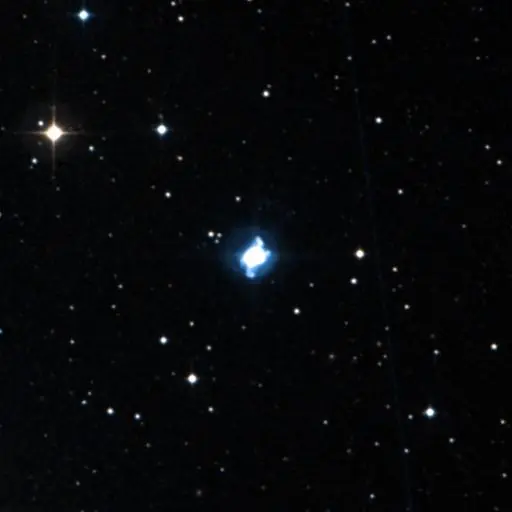
The Turtle: a dying star’s cloud whose outflows have swung in new directions again and again.
Shells, lobes, knots and arches crowd NGC 6210, the Turtle. Astronomers count five different directions in which its central star has thrown out material, and those outflows have changed course sharply since the gas began to glow, around 3,500 years ago. So tangled a shape has led to the idea that three stars, passing material between them, sculpted this planetary nebula.
It sits unusually high above the plane of the Milky Way. Joseph Lalande recorded it as a star in 1799; Wilhelm Struve recognised it as a nebula in 1825.
NGC 6210 is 6,700 light-years away: the light we see from it set off around 4680 BC, 830 years after the first towns were growing in the Fertile Crescent.
Did you know?
- A rippling halo. A faint halo nearly twice the size of the main nebula surrounds it, with four arm-like extensions and at least three faint, circular ripples within it.
How big is it?
1,020 Solar Systems side by side. Light itself takes about a year to cross it. Shrink our Solar System — the Sun and all eight planets — to the size of a coin, and NGC 6210 would be 24.6 m across (about the length of a tennis court); the nearest star would be a football pitch away, and the Milky Way 2,520 km across.
A 9.7-magnitude planetary nebula in Hercules, about 30″ across. Its central star is magnitude 12.7.
When and where to see it
It is best placed in the evening sky around July, when it crosses the meridian at about 10 pm local time (around midnight in June). It can be seen from everywhere north of 66°S and never sets north of 66°N.
At its highest it stands 64° up from 50°N, 79° up from 35°N, 66° up from the equator, 31° up from 35°S.
Facts
- Type
- Planetary nebula
- Constellation
- Hercules
- Designations
- NGC 6210
- Magnitude
- 9.7
- Apparent size
- 30″
- Position
- RA 16h 44.5m, Dec +23° 48′ (J2000)
- Distance
- 6,700 light-years
- Discovered
- Wilhelm Struve, 1825, Recorded as a star by Joseph Lalande in 1799
Open AstroPilot to see when NGC 6210 is highest tonight from your location, how easy it is with your telescope or binoculars, and an eyepiece view.