NGC 6193 (C 82)
NGC 6193 (C 82) is an open cluster in the constellation Ara, magnitude 5.2, 15′ across.
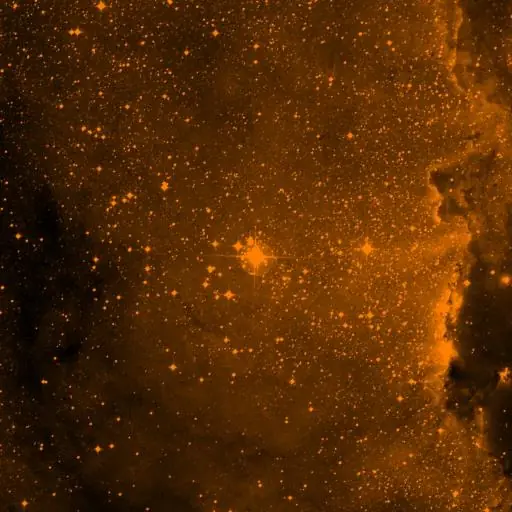
The Firebird Cluster: a nest of giant blue stars setting the clouds of the Altar aglow.
At the centre of NGC 6193 sit two systems of O-type stars — the hottest, most massive kind there is — almost touching on the sky. Around them blaze at least 20 more hot, blue-white B stars. Together they flood their surroundings with ultraviolet light, and the neighbouring cloud NGC 6188 glows in response.
This young open cluster, nicknamed the Firebird, is the core of Ara OB1, a much larger, looser family of massive young stars spread across this part of the sky. Stars this heavy burn out in just a few million years, and the biggest are likely to end as supernovae.
James Dunlop recorded the cluster from Parramatta in 1826. Its constellation, Ara, is the Altar — in Greek myth, the altar on which the gods swore allegiance before their war against the Titans.
NGC 6193 (C 82) is 3,700 light-years away: the light we see from it set off around 1680 BC, 350 years before Tutankhamun was buried in the Valley of the Kings.
Did you know?
- Fighting Dragons. Photographs of the glowing gas next door, NGC 6188, show dark, twisting shapes that astrophotographers call the Fighting Dragons of Ara — clouds being sculpted by the cluster’s light and winds.
- A family the size of five Moons. Ara OB1 is an OB association: a loose gathering of hot, young O and B stars born around the same time. It spreads over about a square degree of sky — roughly five times the area of the full Moon.
How big is it?
Born about 5.1 million years ago, when our ancestors and the chimpanzees' were going their separate ways. Light itself takes 16 years to cross it. Gaia has picked out 653 stars moving together through space as its members. That’s 3.8 times the distance from the Sun to the nearest star. Shrink our Solar System — the Sun and all eight planets — to the size of a coin, and NGC 6193 would be 407 m across (4 football pitches end to end); the nearest star would be a football pitch away, and the Milky Way 2,520 km across.
A young open cluster in Ara whose hot stars light up the nearby emission nebula NGC 6188.
When and where to see it
It is best placed in the evening sky around July, when it crosses the meridian at about 10 pm local time (around midnight in June). It can be seen from everywhere south of 41°N and never sets south of 41°S.
At its highest it stands below the horizon from 50°N, 6° up from 35°N, 41° up from the equator, 76° up from 35°S.
Facts
- Type
- Open cluster
- Constellation
- Ara
- Designations
- C 82
- Magnitude
- 5.2
- Apparent size
- 15′
- Position
- RA 16h 41.3m, Dec −48° 46′ (J2000)
- Distance
- 3,700 light-years
- Discovered
- James Dunlop, 1826
Open AstroPilot to see when NGC 6193 (C 82) is highest tonight from your location, how easy it is with your telescope or binoculars, and an eyepiece view.