Rim Nebula (NGC 6188)
Rim Nebula (NGC 6188) is an emission nebula in the constellation Ara, 20′ × 12′ across.
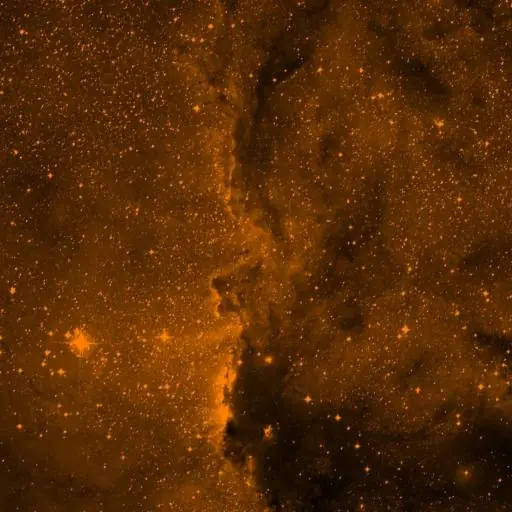
The Fighting Dragons of Ara — a star-forming cloud carved by the young stars it has just made.
Sculpted ridges of glowing gas give NGC 6188 its many names: the Rim Nebula, the Firebird and the Fighting Dragons of Ara. It is a stellar nursery, an emission nebula shaped by massive young stars born inside it, some only a few million years old. The spark for this burst of star birth was probably an earlier generation of stars exploding as supernovae.
Beside it lies the bright young cluster NGC 6193, whose stars light part of the cloud as a reflection nebula. John Herschel found the nebula in 1836.
Rim Nebula (NGC 6188) is 4,000 light-years away: the light we see from it set off around 1980 BC, 590 years after the Great Pyramid of Giza was completed.
Did you know?
- A dragon and its egg. Nearby on the sky, the two-lobed nebula NGC 6164–6165 is nicknamed the Dragon’s Egg because it lies close to these Fighting Dragons.
How big is it?
5.5 times the distance from the Sun to the nearest star. Light itself takes 23 years to cross it. Shrink our Solar System — the Sun and all eight planets — to the size of a coin, and the Rim Nebula would be 587 m across (6 football pitches end to end); the nearest star would be a football pitch away, and the Milky Way 2,520 km across.
An emission nebula in Ara, about 20′ × 12′.
When and where to see it
It is best placed in the evening sky around July, when it crosses the meridian at about 10 pm local time (around midnight in June). It can be seen from everywhere south of 41°N and never sets south of 41°S.
At its highest it stands below the horizon from 50°N, 6° up from 35°N, 41° up from the equator, 76° up from 35°S.
Facts
- Type
- Emission nebula
- Constellation
- Ara
- Designations
- NGC 6188
- Apparent size
- 20′ × 12′
- Position
- RA 16h 40.1m, Dec −48° 40′ (J2000)
- Distance
- 4,000 light-years
- Discovered
- John Herschel, 1836
Open AstroPilot to see when Rim Nebula (NGC 6188) is highest tonight from your location, how easy it is with your telescope or binoculars, and an eyepiece view.