NGC 6169
NGC 6169 is an open cluster in the constellation Norma, magnitude 6.6, 4.2′ across.
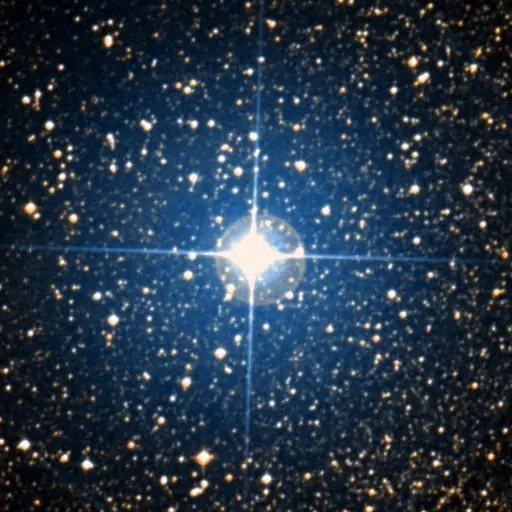
A star cluster that may not be one at all — Gaia suggests its stars only line up by chance.
Is it a cluster at all? A 2013 catalogue listed NGC 6169 as a young open cluster about 32 million years old. But in 2020 a study using the Gaia spacecraft’s precise measurements of star positions and motions found that its stars are not physically linked — which would make it an asterism, a chance grouping on the sky. It lies near the star Mu Normae. John Herschel recorded it in 1834.
NGC 6169 is 3,300 light-years away: the light we see from it set off around 1280 BC, around the time Tutankhamun was buried in the Valley of the Kings.
How big is it?
About as wide as the distance from the Sun to the nearest star. Light itself takes 4 years to cross it. Shrink our Solar System — the Sun and all eight planets — to the size of a coin, and NGC 6169 would be 102 m across (about the length of a football pitch); the nearest star would be a football pitch away, and the Milky Way 2,520 km across.
A 6.6-magnitude open cluster in Norma, about 4.2′ across.
When and where to see it
It is best placed in the evening sky around June, when it crosses the meridian at about 10 pm local time (around midnight in June). It can be seen from everywhere south of 46°N and never sets south of 46°S.
At its highest it stands below the horizon from 50°N, 11° up from 35°N, 46° up from the equator, 81° up from 35°S.
Facts
- Type
- Open cluster
- Constellation
- Norma
- Designations
- NGC 6169
- Magnitude
- 6.6
- Apparent size
- 4.2′
- Position
- RA 16h 34.1m, Dec −44° 3′ (J2000)
- Distance
- 3,300 light-years
- Discovered
- John Herschel, 1834
Open AstroPilot to see when NGC 6169 is highest tonight from your location, how easy it is with your telescope or binoculars, and an eyepiece view.