NGC 6164
NGC 6164 is an emission nebula in the constellation Norma, magnitude 6.7, 1.4′ × 36″ across.
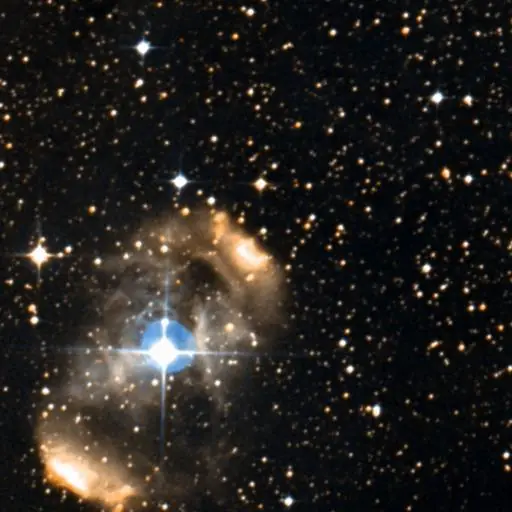
The northern half of the Dragon’s Egg — gas thrown off by a young, magnetic giant star.
Look at the Dragon’s Egg and you might think of a dying Sun-like star puffing off its outer layers. It isn’t one. NGC 6164 is the northern lobe of a two-lobed emission nebula, blown out by HD 148937 — a young, hot O-type star of about 40 Suns, wrapped in a magnetic field. The same star sets the gas glowing. John Herschel found the nebula on 1 July 1834.
NGC 6164 is 3,800 light-years away: the light we see from it set off around 1780 BC, 450 years before Tutankhamun was buried in the Valley of the Kings.
Did you know?
- Why “Dragon’s Egg”?. The nebula owes its nickname to its neighbours on the sky: it lies near the Fighting Dragons of Ara, the glowing cloud also known as NGC 6188.
- Born from a stellar merger. In 2024 astronomers found that HD 148937 is really two stars, one strangely young-looking and strongly magnetic. The best explanation: two stars merged in a violent event that also threw out the surrounding nebula.
How big is it?
1,640 Solar Systems side by side. Light itself takes 1.6 years to cross it. Shrink our Solar System — the Sun and all eight planets — to the size of a coin, and NGC 6164 would be 39.3 m across (about the length of an Olympic pool); the nearest star would be a football pitch away, and the Milky Way 2,520 km across.
An emission nebula in Norma, about 1.4′ × 0.6′. Its catalogued magnitude, 6.7, is that of the star lighting it; the nebula itself is much fainter.
When and where to see it
It is best placed in the evening sky around June, when it crosses the meridian at about 10 pm local time (around midnight in May). It can be seen from everywhere south of 42°N and never sets south of 42°S.
At its highest it stands below the horizon from 50°N, 7° up from 35°N, 42° up from the equator, 77° up from 35°S.
Facts
- Type
- Emission nebula
- Constellation
- Norma
- Designations
- NGC 6164
- Magnitude
- 6.7
- Apparent size
- 1.4′ × 36″
- Position
- RA 16h 33.7m, Dec −48° 5′ (J2000)
- Distance
- 3,800 light-years
- Discovered
- John Herschel, 1834
Open AstroPilot to see when NGC 6164 is highest tonight from your location, how easy it is with your telescope or binoculars, and an eyepiece view.