NGC 613
NGC 613 is a galaxy in the constellation Sculptor, magnitude 10.3, 5.5′ × 4.5′ across.
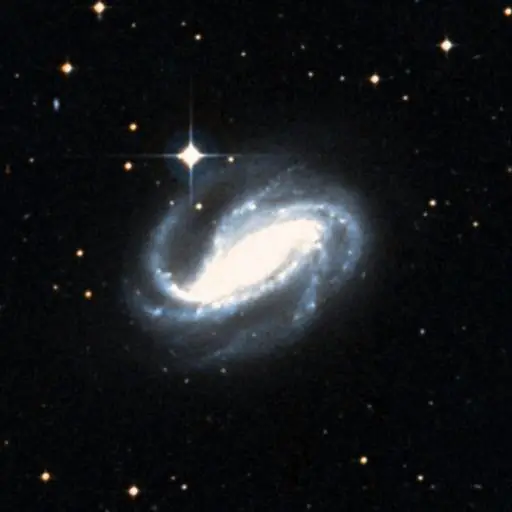
A barred spiral where an amateur caught a star in the very first moments of exploding.
In 1912 a photograph showed what eyes had missed: NGC 613 is a spiral. Today we know it as a barred spiral galaxy, with a broad bar across its centre, dust lanes along the bar’s leading edges and new stars forming at its tips. Radio telescopes later found a strong source in its core, where a black hole of tens of millions of solar masses probably lies.
William Herschel discovered it on 9 December 1798, and James Dunlop found it again from Australia in 1826.
NGC 613 is 73 million light-years away: the light we see from it set off about 73 million years ago, when dinosaurs still walked the Earth.
Did you know?
- The luckiest picture. On 20 September 2016 Argentinian amateur Victor Buso photographed NGC 613 just as a star in it was starting to explode, catching the birth of supernova SN 2016gkg. Hubble images taken earlier show the star before it died: probably a yellow supergiant.
How big is it?
1.2 times as wide as our Milky Way. Light itself takes 120,000 years to cross it. Shrink it to the length of a football pitch and our whole Solar System would be smaller than a bacterium.
A 10.3-magnitude spiral galaxy (Sbc) in Sculptor, about 5.5′ × 4.5′.
When and where to see it
It is best placed in the evening sky around November, when it crosses the meridian at about 10 pm local time (around midnight in October). It can be seen from everywhere south of 61°N and never sets south of 61°S.
At its highest it stands 11° up from 50°N, 26° up from 35°N, 61° up from the equator, 84° up from 35°S.
Facts
- Type
- Galaxy
- Constellation
- Sculptor
- Designations
- NGC 613
- Magnitude
- 10.3
- Apparent size
- 5.5′ × 4.5′
- Position
- RA 1h 34.3m, Dec −29° 25′ (J2000)
- Distance
- 73 million light-years
- Discovered
- William Herschel, 1798, Found again by James Dunlop in 1826
Open AstroPilot to see when NGC 613 is highest tonight from your location, how easy it is with your telescope or binoculars, and an eyepiece view.