NGC 6124 (C 75)
NGC 6124 (C 75) is an open cluster in the constellation Scorpius, magnitude 5.8, 29′ across.
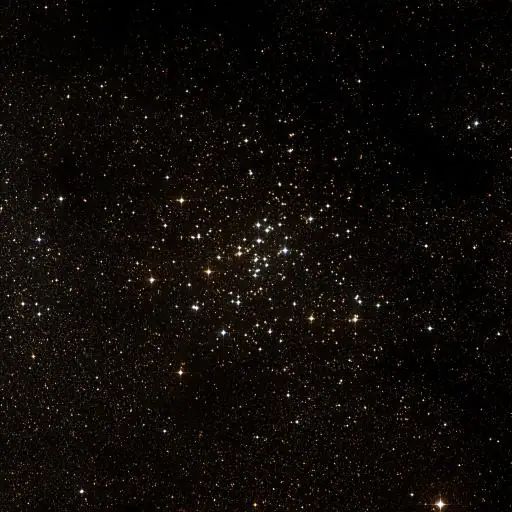
A swarm of more than a hundred stars, first logged by a French abbé charting the southern sky from Africa.
Picture a French abbé at the Cape of Good Hope in 1751, charting the southern stars night after night. Nicolas-Louis de Lacaille had come to map the sky that Europe could not see, and along the way he noted a few dozen fuzzy patches that were not single stars at all. NGC 6124 was one of them.
It is an open cluster in Scorpius, a family of about 125 stars. Like every open cluster, its members were born together from a single cloud of gas and dust, so they share the same age and the same make-up. Over many millions of years the galaxy’s gravity will tug them apart, until they drift off as separate stars across the Milky Way — just as the Sun’s own birth siblings are thought to have done long ago.
NGC 6124 (C 75) is 2,000 light-years away: the light we see from it set off around AD 30, around the time Vesuvius buried Pompeii.
Did you know?
- A sky full of instruments. Lacaille named 14 new southern constellations, most after tools of science and art: the telescope, the microscope, the air pump, the painter’s easel and the chemist’s furnace among them.
- Ten thousand stars. From the Cape, Lacaille recorded the positions of nearly 10,000 southern stars. His great catalogue was published in 1763, a year after his death.
How big is it?
Born about 190 million years ago, when dinosaurs were rising and the supercontinent Pangaea was breaking apart. Light itself takes 17 years to cross it. Gaia has picked out 1,671 stars moving together through space as its members. That’s 4 times the distance from the Sun to the nearest star. Shrink our Solar System — the Sun and all eight planets — to the size of a coin, and NGC 6124 would be 426 m across (4 football pitches end to end); the nearest star would be a football pitch away, and the Milky Way 2,520 km across.
A large, bright open cluster in Scorpius, easy in binoculars and rich at low power.
When and where to see it
It is best placed in the evening sky around June, when it crosses the meridian at about 10 pm local time (around midnight in May). It can be seen from everywhere south of 49°N and never sets south of 49°S.
At its highest it stands below the horizon from 50°N, 14° up from 35°N, 49° up from the equator, 84° up from 35°S.
Facts
- Type
- Open cluster
- Constellation
- Scorpius
- Designations
- C 75, Mel 145, Cr 301, Melotte 145, Collinder 301
- Magnitude
- 5.8
- Apparent size
- 29′
- Position
- RA 16h 25.3m, Dec −40° 39′ (J2000)
- Distance
- 2,000 light-years
- Discovered
- Nicolas-Louis de Lacaille, 1751
Open AstroPilot to see when NGC 6124 (C 75) is highest tonight from your location, how easy it is with your telescope or binoculars, and an eyepiece view.