S Normae Cluster (NGC 6087)
S Normae Cluster (NGC 6087) is an open cluster in the constellation Norma, magnitude 5.4, 10′ across.
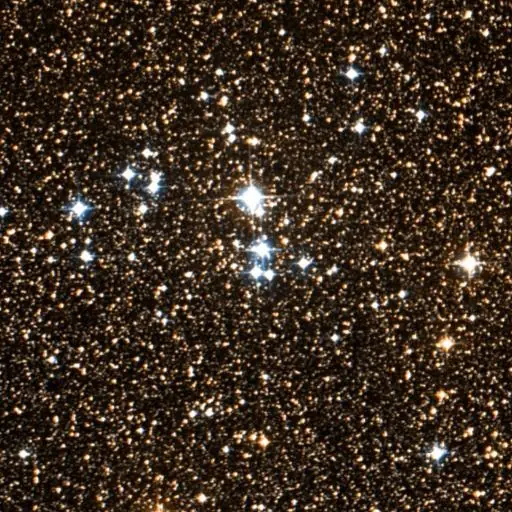
A star cluster with a heartbeat — its brightest member swells and fades like clockwork, every ten days.
At the heart of this cluster, one star breathes. S Normae is a Cepheid variable: a yellow supergiant that swells and shrinks in a steady rhythm, brightening and fading every 9.75 days or so. Around it gather 40 or more fainter siblings, all born from the same cloud.
Cepheids matter because their rhythm gives away their true brightness. In 1912 Henrietta Swan Leavitt, one of Harvard’s women “computers”, showed that the slower a Cepheid pulses, the more luminous it really is. Compare that with how bright the star looks, and you know how far away it is.
That makes S Normae precious. Spectra show it moves through space together with the rest of the cluster, so it is a genuine member, not a chance passer-by. Its neighbours give an independent check on its distance — and Cepheids in clusters like this one are used to calibrate the yardstick that reaches out to other galaxies.
S Normae Cluster (NGC 6087) is 3,100 light-years away: the light we see from it set off around 1080 BC, 250 years after Tutankhamun was buried in the Valley of the Kings.
Did you know?
- A rule that measured the universe. Leavitt found her rule using Cepheids in the Small Magellanic Cloud. In the 1920s Edwin Hubble applied it to Cepheids in the “spiral nebulae” and proved they are galaxies far beyond our own.
- Found from Parramatta. James Dunlop, a Scottish astronomer working at Parramatta near Sydney, recorded the cluster in 1826 while sweeping the southern sky for nebulae and star clusters.
How big is it?
Born about 100 million years ago, when dinosaurs still walked the Earth. Light itself takes 9.2 years to cross it. Gaia has picked out 360 stars moving together through space as its members. That’s 2.2 times the distance from the Sun to the nearest star. Shrink our Solar System — the Sun and all eight planets — to the size of a coin, and the S Normae Cluster would be 232 m across (2 football pitches end to end); the nearest star would be a football pitch away, and the Milky Way 2,520 km across.
A bright open cluster in Norma centered on the Cepheid variable S Normae.
When and where to see it
It is best placed in the evening sky around June, when it crosses the meridian at about 10 pm local time (around midnight in May). It can be seen from everywhere south of 32°N and never sets south of 32°S.
At its highest it stands below the horizon from 50°N, below the horizon from 35°N, 32° up from the equator, 67° up from 35°S.
Facts
- Type
- Open cluster
- Constellation
- Norma
- Designations
- NGC 6087, C 89
- Magnitude
- 5.4
- Apparent size
- 10′
- Position
- RA 16h 18.8m, Dec −57° 56′ (J2000)
- Distance
- 3,100 light-years
- Discovered
- James Dunlop, 1826
Open AstroPilot to see when S Normae Cluster (NGC 6087) is highest tonight from your location, how easy it is with your telescope or binoculars, and an eyepiece view.