NGC 6025 (C 95)
NGC 6025 (C 95) is an open cluster in the constellation Triangulum Australe, magnitude 5.1, 15′ across.
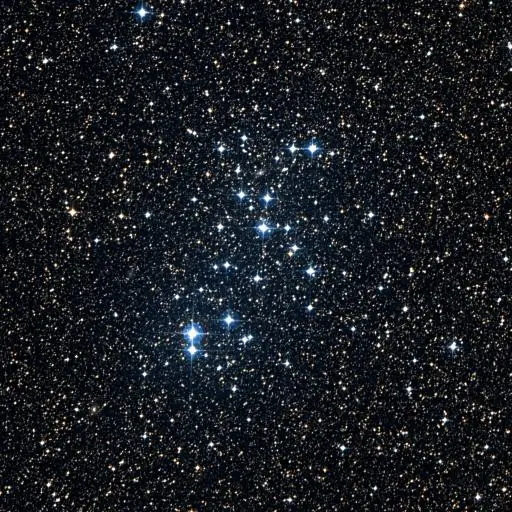
A young star cluster cut in two by a line on the sky — half in Norma, half in the Southern Triangle.
A ruler-straight border runs right through this family of stars. When Eugène Delporte drew the official constellation boundaries for the International Astronomical Union, his line split NGC 6025 down the middle: its northern stars belong to Norma, its southern ones to Triangulum Australe. The stars, of course, never noticed.
They are a young open cluster, born between 40 and 69 million years ago — around the time the dinosaurs died out, or a little later. Nicolas-Louis de Lacaille found it in 1751, during his expedition to the Cape of Good Hope to chart the southern sky. Fittingly, half of it now lies in Norma, the carpenter’s square, one of the constellations Lacaille himself invented.
NGC 6025 (C 95) is 2,500 light-years away: the light we see from it set off around 480 BC, around the time the Parthenon was dedicated in Athens.
Did you know?
- A straggler in the family. Its brightest star, MQ Trianguli Australis, is a blue straggler — hotter and bluer than a star of the cluster’s age should be. Such stars are thought to have gained extra mass from a companion or a merger. It is the only one found here.
- Built in pairs. Seven of its stars are spectroscopic binaries: pairs so tight that no telescope can split them, revealed only by the to-and-fro shift of the lines in their light.
- Richer than the Hyades. To astronomers, every element heavier than helium is a “metal”. NGC 6025’s stars hold more of them than the Sun does — more, even, than the well-studied Hyades cluster in Taurus.
How big is it?
Born about 100 million years ago, when dinosaurs still walked the Earth. Light itself takes 11 years to cross it. Gaia has picked out 555 stars moving together through space as its members. That’s 2.6 times the distance from the Sun to the nearest star. Shrink our Solar System — the Sun and all eight planets — to the size of a coin, and NGC 6025 would be 275 m across (3 football pitches end to end); the nearest star would be a football pitch away, and the Milky Way 2,520 km across.
A bright open cluster in Triangulum Australe, easy in binoculars.
When and where to see it
It is best placed in the evening sky around June, when it crosses the meridian at about 10 pm local time (around midnight in May). It can be seen from everywhere south of 30°N and never sets south of 30°S.
At its highest it stands below the horizon from 50°N, below the horizon from 35°N, 30° up from the equator, 65° up from 35°S.
Facts
- Type
- Open cluster
- Constellation
- Triangulum Australe
- Designations
- C 95, Mel 139, Cr 296, Melotte 139, Collinder 296
- Magnitude
- 5.1
- Apparent size
- 15′
- Position
- RA 16h 3.3m, Dec −60° 26′ (J2000)
- Distance
- 2,500 light-years
- Discovered
- Nicolas-Louis de Lacaille, 1751
Open AstroPilot to see when NGC 6025 (C 95) is highest tonight from your location, how easy it is with your telescope or binoculars, and an eyepiece view.