NGC 5907 (NGC 5906)
NGC 5907 (NGC 5906) is a galaxy in the constellation Draco, magnitude 10.4, 11′ × 1.8′ across.
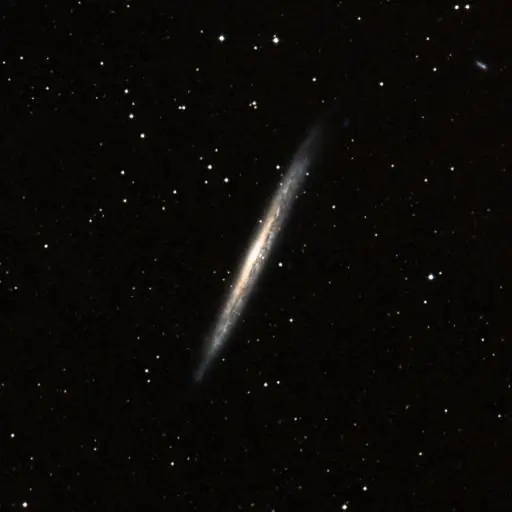
The Splinter Galaxy: a razor-thin spiral hosting one of the brightest neutron stars ever found.
Seen edge-on, NGC 5907 is a thin sliver of light — hence its names, the Splinter and the Knife Edge. For a long time it was the textbook example of a warped spiral living alone. Then faint loops of stars were found around it, the remains of a torn-apart dwarf galaxy whose pull may have bent the disc. Deeper images suggest a single, knee-shaped stream rather than the double loop first reported. William Herschel found the galaxy on 5 May 1788.
NGC 5907 (NGC 5906) is 56 million light-years away: the light we see from it set off about 56 million years ago, when mammals were taking over a world without dinosaurs.
Did you know?
- An overachieving neutron star. NGC 5907 ULX-1 is a neutron star spinning once every 1.13 seconds, and speeding up. At its peak it shines more than 1,000 times brighter than the theoretical limit for such an object — one of the brightest X-ray sources of its kind.
- Two numbers. It is also NGC 5906: in 1850 George Johnstone Stoney, Lord Rosse’s assistant, recorded the fainter strip beyond the dust lane as a separate object.
How big is it?
1.8 times as wide as our Milky Way. Light itself takes 180,000 years to cross it. Shrink it to the length of a football pitch and our whole Solar System would be smaller than a bacterium.
A 10.4-magnitude weakly barred spiral galaxy (SABc) in Draco, about 11′ × 1.8′.
When and where to see it
It is best placed in the evening sky around June, when it crosses the meridian at about 10 pm local time (around midnight in May). It can be seen from everywhere north of 34°S and never sets north of 34°N.
At its highest it stands 84° up from 50°N, 69° up from 35°N, 34° up from the equator, below the horizon from 35°S.
Facts
- Type
- Galaxy
- Constellation
- Draco
- Designations
- NGC 5906
- Magnitude
- 10.4
- Apparent size
- 11′ × 1.8′
- Position
- RA 15h 15.9m, Dec +56° 20′ (J2000)
- Distance
- 56 million light-years
- Discovered
- William Herschel, 1788
Open AstroPilot to see when NGC 5907 (NGC 5906) is highest tonight from your location, how easy it is with your telescope or binoculars, and an eyepiece view.