NGC 584 (IC 1712)
NGC 584 (IC 1712) is a galaxy in the constellation Cetus, magnitude 10.3, 3.8′ × 2.5′ across.
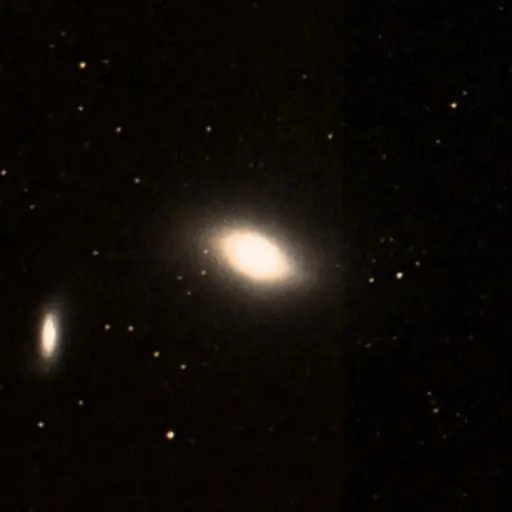
A smooth elliptical galaxy that ended up with two catalogue names.
Elliptical galaxies are smooth, rounded swarms of stars, with little of the gas and dust that spirals use to build new ones. NGC 584 is one of these, and gives its name to a small group that also includes NGC 596, NGC 600, NGC 615 and NGC 636. William Herschel found it on 10 September 1785. It was later catalogued a second time, so it also carries the name IC 1712.
NGC 584 (IC 1712) is 66 million light-years away: the light we see from it set off about 66 million years ago, when dinosaurs still walked the Earth.
How big is it?
73% of the Milky Way’s width. Light itself takes 73,000 years to cross it. Shrink it to the length of a football pitch and our whole Solar System would be smaller than a bacterium.
A 10.3-magnitude elliptical galaxy (E) in Cetus, about 3.8′ × 2.5′.
When and where to see it
It is best placed in the evening sky around November, when it crosses the meridian at about 10 pm local time (around midnight in October). It can be seen from everywhere south of 83°N and never sets south of 83°S.
At its highest it stands 33° up from 50°N, 48° up from 35°N, 83° up from the equator, 62° up from 35°S.
Facts
- Type
- Galaxy
- Constellation
- Cetus
- Designations
- IC 1712
- Magnitude
- 10.3
- Apparent size
- 3.8′ × 2.5′
- Position
- RA 1h 31.3m, Dec −6° 52′ (J2000)
- Distance
- 66 million light-years
- Discovered
- William Herschel, 1785
Open AstroPilot to see when NGC 584 (IC 1712) is highest tonight from your location, how easy it is with your telescope or binoculars, and an eyepiece view.