NGC 5823 (C 88)
NGC 5823 (C 88) is an open cluster in the constellation Circinus, magnitude 7.9, 10′ across.
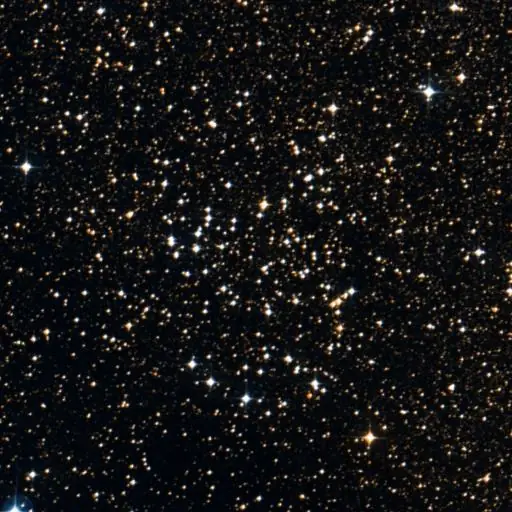
A star cluster straddling the border between an ancient wolf and an 18th-century drawing compass.
NGC 5823 refuses to stay inside the lines. It lies in Circinus but spills across the border into neighbouring Lupus — two constellations that could hardly be more different in age. Lupus, the Wolf, dates from antiquity and was listed by Ptolemy. Circinus, the drawing compass, was invented by Nicolas-Louis de Lacaille in the 1750s.
Like every open cluster, it is a family of stars born together from the same cloud of gas, which will slowly drift apart as the pull of the galaxy works on them.
James Dunlop discovered it in 1826, while cataloguing the southern sky from Parramatta in New South Wales.
NGC 5823 (C 88) is 5,700 light-years away: the light we see from it set off around 3680 BC, 470 years before writing was invented in Mesopotamia.
Did you know?
- Instruments among the stars. Circinus is one of the constellations Lacaille created for the southern sky, many of them named after tools of science and art, such as the telescope, the microscope and the air pump.
- A Scot in Australia. James Dunlop, a Scottish-born astronomer, catalogued hundreds of southern clusters and nebulae from Parramatta, and many of the Caldwell objects in the far south are his finds.
How big is it?
Born about 79 million years ago, when dinosaurs still walked the Earth. Light itself takes 17 years to cross it. Gaia has picked out 677 stars moving together through space as its members. That’s 3.9 times the distance from the Sun to the nearest star. Shrink our Solar System — the Sun and all eight planets — to the size of a coin, and NGC 5823 would be 418 m across (4 football pitches end to end); the nearest star would be a football pitch away, and the Milky Way 2,520 km across.
A rich open cluster on the border of Circinus and Lupus, a fine scattering of faint stars at low power.
When and where to see it
It is best placed in the evening sky around June, when it crosses the meridian at about 10 pm local time (around midnight in May). It can be seen from everywhere south of 34°N and never sets south of 34°S.
At its highest it stands below the horizon from 50°N, below the horizon from 35°N, 34° up from the equator, 69° up from 35°S.
Facts
- Type
- Open cluster
- Constellation
- Circinus
- Designations
- C 88
- Magnitude
- 7.9
- Apparent size
- 10′
- Position
- RA 15h 5.5m, Dec −55° 36′ (J2000)
- Distance
- 5,700 light-years
- Discovered
- James Dunlop, 1826
Open AstroPilot to see when NGC 5823 (C 88) is highest tonight from your location, how easy it is with your telescope or binoculars, and an eyepiece view.