NGC 5822
NGC 5822 is an open cluster in the constellation Lupus, magnitude 6.5, 18′ across.
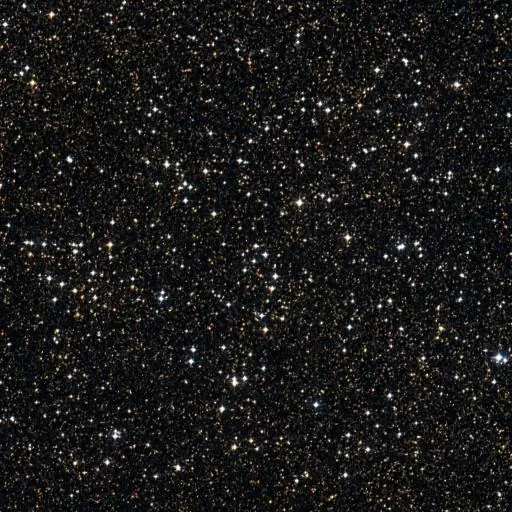
A 900-million-year-old cluster in Lupus, one of the few known to hold barium stars.
Most open clusters scatter long before they reach a billion years. NGC 5822, at about 900 million, is still holding together — a rich open cluster of some 1,700 Suns’ worth of stars with almost exactly the Sun’s chemistry. The stars now leaving their long, steady middle age form a broader band than expected, probably because they spin at different speeds. Right beside it lies another cluster, NGC 5823, and the two may be related. John Herschel found it on 3 July 1836.
NGC 5822 is 2,600 light-years away: the light we see from it set off around 580 BC, 135 years before the Parthenon was dedicated in Athens.
Did you know?
- Barium stars. Two barium stars live here: giants enriched in barium, probably passed to them by a companion that is now a white dwarf. In 2013 that made NGC 5822 only the second cluster known to host them.
How big is it?
Born about 910 million years ago, when there were no animals on Earth at all. Light itself takes 14 years to cross it. Gaia has picked out 804 stars moving together through space as its members. That’s 3.2 times the distance from the Sun to the nearest star. Shrink our Solar System — the Sun and all eight planets — to the size of a coin, and NGC 5822 would be 344 m across (3 football pitches end to end); the nearest star would be a football pitch away, and the Milky Way 2,520 km across.
A 6.5-magnitude open cluster in Lupus, about 18′ across.
When and where to see it
It is best placed in the evening sky around June, when it crosses the meridian at about 10 pm local time (around midnight in May). It can be seen from everywhere south of 36°N and never sets south of 36°S.
At its highest it stands below the horizon from 50°N, 1° up from 35°N, 36° up from the equator, 71° up from 35°S.
Facts
- Type
- Open cluster
- Constellation
- Lupus
- Designations
- NGC 5822
- Magnitude
- 6.5
- Apparent size
- 18′
- Position
- RA 15h 4.4m, Dec −54° 24′ (J2000)
- Distance
- 2,600 light-years
- Discovered
- John Herschel, 1836
Open AstroPilot to see when NGC 5822 is highest tonight from your location, how easy it is with your telescope or binoculars, and an eyepiece view.