NGC 5662 (Mel 127)
NGC 5662 (Mel 127) is an open cluster in the constellation Centaurus, magnitude 5.5, 29′ across.
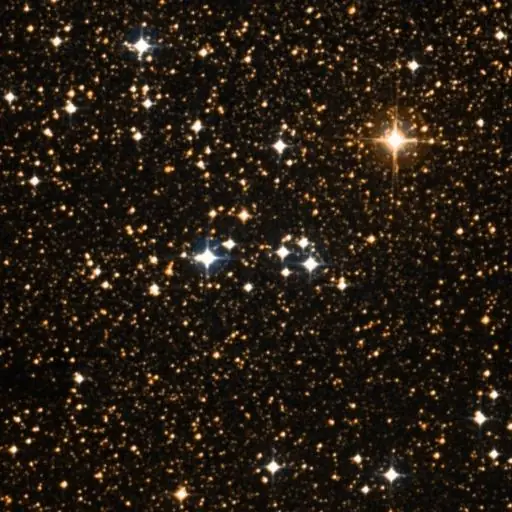
A rich southern cluster with a pulsing Cepheid among its members — one of astronomy’s yardsticks.
Among the nearly 300 stars of NGC 5662 is V Centauri, a Cepheid: a pulsating giant star that swells and shrinks in a steady rhythm. Because a Cepheid’s rhythm reveals its true brightness, one that belongs to a cluster is precious — the cluster helps calibrate the yardstick astronomers use to measure other galaxies. V Centauri sits far from the cluster’s centre but is still very likely a member. Nicolas Louis de Lacaille discovered this open cluster on 17 May 1752 from the Cape of Good Hope.
NGC 5662 (Mel 127) is 2,400 light-years away: the light we see from it set off around 380 BC, around the time the Parthenon was dedicated in Athens.
How big is it?
Born about 200 million years ago, when dinosaurs were rising and the supercontinent Pangaea was breaking apart. Light itself takes 20 years to cross it. Gaia has picked out 439 stars moving together through space as its members. That’s 4.8 times the distance from the Sun to the nearest star. Shrink our Solar System — the Sun and all eight planets — to the size of a coin, and NGC 5662 would be 511 m across (5 football pitches end to end); the nearest star would be a football pitch away, and the Milky Way 2,520 km across.
A 5.5-magnitude open cluster in Centaurus, about 29′ across.
When and where to see it
It is best placed in the evening sky around June, when it crosses the meridian at about 10 pm local time (around midnight in May). It can be seen from everywhere south of 33°N and never sets south of 33°S.
At its highest it stands below the horizon from 50°N, below the horizon from 35°N, 33° up from the equator, 68° up from 35°S.
Facts
- Type
- Open cluster
- Constellation
- Centaurus
- Designations
- Mel 127, Cr 284, Melotte 127, Collinder 284
- Magnitude
- 5.5
- Apparent size
- 29′
- Position
- RA 14h 35.6m, Dec −56° 37′ (J2000)
- Distance
- 2,400 light-years
- Discovered
- Nicolas Louis de Lacaille, 1752
Open AstroPilot to see when NGC 5662 (Mel 127) is highest tonight from your location, how easy it is with your telescope or binoculars, and an eyepiece view.