NGC 5643
NGC 5643 is a galaxy in the constellation Lupus, magnitude 10.8 (blue), 5.3′ × 4.6′ across.
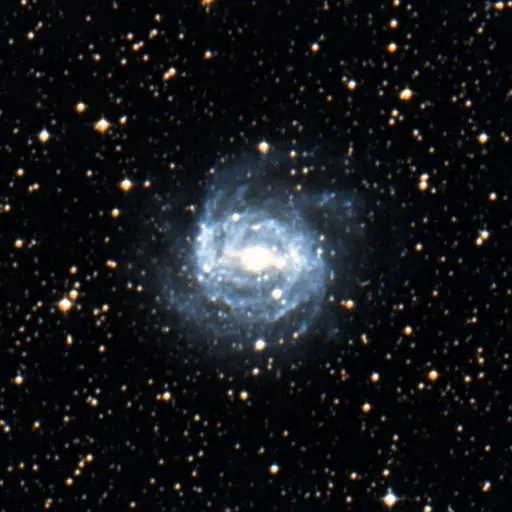
A face-on spiral with a hidden black hole, and the brightest supernova of 2013.
Two broad, symmetric arms make NGC 5643 a grand-design spiral, seen almost face-on. Its heart is active but hidden: a thick wall of gas and dust blocks our direct view of the nucleus, yet Hubble images show a V-shaped cone of glowing gas lit by the central black hole, lined up with a radio jet. Near the centre, an X-ray source thought to be a black hole of about 30 Suns outshines the core in X-rays. James Dunlop found the galaxy on 10 May 1826.
NGC 5643 is 41 million light-years away: the light we see from it set off about 41 million years ago, when mammals were taking over a world without dinosaurs.
Did you know?
- Supernova 2013aa. Stuart Parker, an amateur astronomer in New Zealand, found a Type Ia supernova here on 13 February 2013. It reached magnitude 11.3, the brightest supernova of that year.
How big is it?
63% of the Milky Way’s width. Light itself takes 63,000 years to cross it. Shrink it to the length of a football pitch and our whole Solar System would be smaller than a bacterium.
A 10.8-magnitude (B-band) spiral galaxy (Sc) in Lupus, about 5.3′ × 4.6′.
When and where to see it
It is best placed in the evening sky around May, when it crosses the meridian at about 10 pm local time (around midnight in May). It can be seen from everywhere south of 46°N and never sets south of 46°S.
At its highest it stands below the horizon from 50°N, 11° up from 35°N, 46° up from the equator, 81° up from 35°S.
Facts
- Type
- Galaxy
- Constellation
- Lupus
- Designations
- NGC 5643
- Magnitude
- 10.8 (blue)
- Apparent size
- 5.3′ × 4.6′
- Position
- RA 14h 32.7m, Dec −44° 10′ (J2000)
- Distance
- 41 million light-years
- Discovered
- James Dunlop, 1826
Open AstroPilot to see when NGC 5643 is highest tonight from your location, how easy it is with your telescope or binoculars, and an eyepiece view.