NGC 559 (C 8)
NGC 559 (C 8) is an open cluster in the constellation Cassiopeia, magnitude 9.5, 9.0′ across.
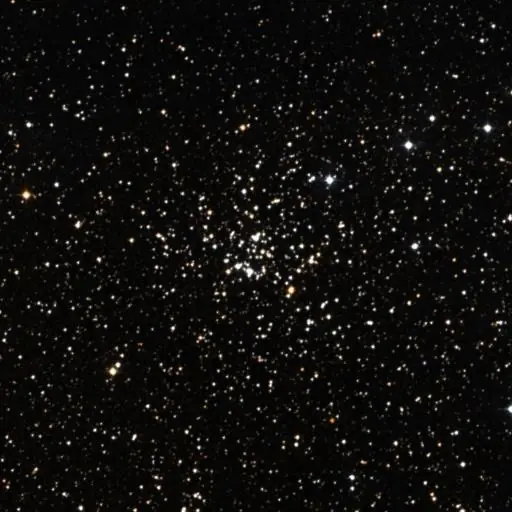
The Ghost’s Goblet: an ancient star cluster that looks ready to vanish like a phantom’s cup.
Astronomer Stephen J. O’Meara looked at this cluster in Cassiopeia and saw a jewelled goblet in the instant before it vanishes, like a ghost. He named it the Ghost’s Goblet. The fading impression, he said, comes from the many faint stars at its centre — and from the cluster’s great age.
William Herschel discovered it in 1787, and Patrick Moore later included it as number 8 in his Caldwell catalogue. At about 1.8 billion years old, it is an elder among open clusters, most of which break apart long before they reach such an age.
NGC 559 (C 8) is 9,000 light-years away: the light we see from it set off around 6980 BC, 1,470 years before the first towns were growing in the Fertile Crescent.
Did you know?
- A survivor. Most star clusters break up within about 50 million years. NGC 559 has already held together dozens of times longer than that.
- Older than it looks. When the stars of NGC 559 were born, some 1.8 billion years ago, life on Earth was still almost entirely microscopic.
How big is it?
Born about 260 million years ago, when the first plants and animals were moving onto land. Light itself takes 24 years to cross it. Gaia has picked out 887 stars moving together through space as its members. That’s 5.6 times the distance from the Sun to the nearest star. Shrink our Solar System — the Sun and all eight planets — to the size of a coin, and NGC 559 would be 595 m across (6 football pitches end to end); the nearest star would be a football pitch away, and the Milky Way 2,520 km across.
A compact open cluster in Cassiopeia, a rich patch of faint stars in small telescopes.
When and where to see it
It is best placed in the evening sky around November, when it crosses the meridian at about 10 pm local time (around midnight in October). It can be seen from everywhere north of 27°S and never sets north of 27°N.
At its highest it stands 77° up from 50°N, 62° up from 35°N, 27° up from the equator, below the horizon from 35°S.
Facts
- Type
- Open cluster
- Constellation
- Cassiopeia
- Designations
- C 8
- Magnitude
- 9.5
- Apparent size
- 9.0′
- Position
- RA 1h 29.5m, Dec +63° 18′ (J2000)
- Distance
- 9,000 light-years
- Discovered
- William Herschel, 1787
Open AstroPilot to see when NGC 559 (C 8) is highest tonight from your location, how easy it is with your telescope or binoculars, and an eyepiece view.