NGC 5322
NGC 5322 is a galaxy in the constellation Ursa Major, magnitude 10.1, 5.6′ × 3.5′ across.
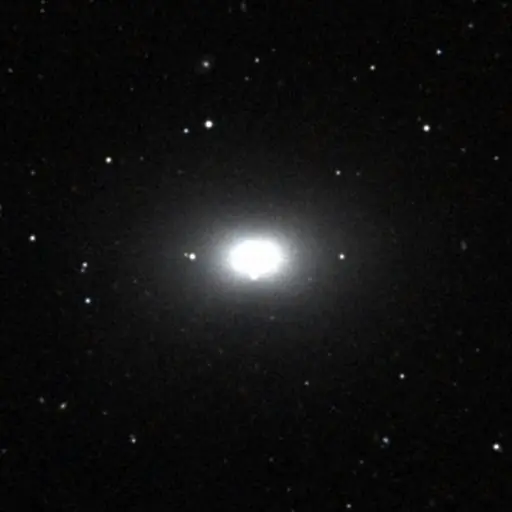
An elliptical galaxy with a disc of stars spinning the wrong way — the remains of a swallowed companion.
Inside NGC 5322 lie the remains of another galaxy. A flat disc of stars at its centre turns the opposite way to the rest of this elliptical galaxy — most likely all that is left of a gas-rich satellite it swallowed. A thin disc of dust, seen edge-on, crosses the core. The black hole there, of a few hundred million Suns, feeds quietly on gas and fires two symmetric radio jets out at right angles to that dust. William Herschel found the galaxy on 19 March 1790. It leads a small group of its own.
NGC 5322 is 100 million light-years away: the light we see from it set off about 100 million years ago, when dinosaurs still walked the Earth.
How big is it?
1.6 times as wide as our Milky Way. Light itself takes 160,000 years to cross it. Shrink it to the length of a football pitch and our whole Solar System would be smaller than a bacterium.
A 10.1-magnitude elliptical galaxy (E) in Ursa Major, about 5.6′ × 3.5′.
When and where to see it
It is best placed in the evening sky around May, when it crosses the meridian at about 10 pm local time (around midnight in April). It can be seen from everywhere north of 30°S and never sets north of 30°N.
At its highest it stands 80° up from 50°N, 65° up from 35°N, 30° up from the equator, below the horizon from 35°S.
Facts
- Type
- Galaxy
- Constellation
- Ursa Major
- Designations
- NGC 5322
- Magnitude
- 10.1
- Apparent size
- 5.6′ × 3.5′
- Position
- RA 13h 49.3m, Dec +60° 11′ (J2000)
- Distance
- 100 million light-years
- Discovered
- William Herschel, 1790
Open AstroPilot to see when NGC 5322 is highest tonight from your location, how easy it is with your telescope or binoculars, and an eyepiece view.